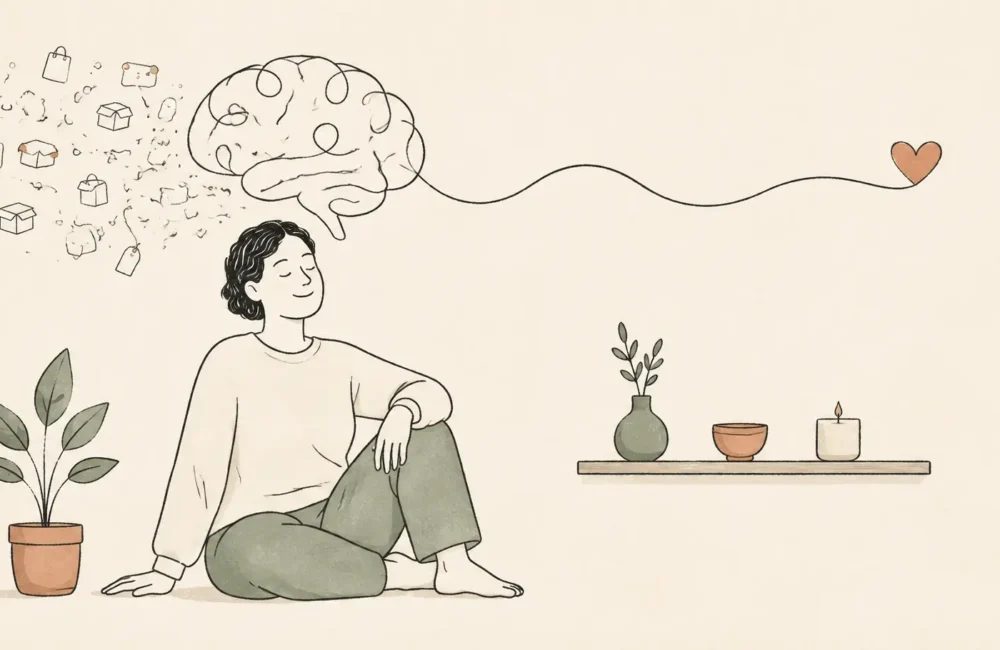

Minimalism is often shown as an empty white room or a promise that owning less solves every problem. Psychology offers a more useful view: deliberately reducing low-value possessions, commitments, and digital inputs so that time and attention reflect what matters.
Quick answer: The psychology of minimalism is about intentional choice, not counting objects. Research links mindful, low-consumption lifestyles with some positive emotional and environmental outcomes, but it does not prove that minimalism causes happiness or treats mental illness. Benefits depend on autonomy, values, circumstances, and what replaces the excess.
What Is the Psychology of Minimalism?
The psychology of minimalism examines why people voluntarily reduce excess and how that choice may affect attention, identity, emotions, relationships, consumption, and well-being. A psychologically useful form of minimalism asks, “Does this support the life I want to live?” rather than, “How little can I own?”
Minimalism may involve physical belongings, but it can also apply to schedules, spending, notifications, subscriptions, goals, and social obligations. It overlaps with voluntary simplicity—a chosen low-consumption lifestyle—but it is not identical to a tidy aesthetic or a strict no-buy challenge.
Values matter because reducing possessions without a meaningful reason can feel like deprivation. If you are unsure what “enough” means for you, BeyondPsycHub’s values alignment assessment can help you identify the principles you want your time, money, and environment to support.
| Concept | What it means | What it does not mean |
|---|---|---|
| Minimalism | Intentionally keeping or doing what serves a purpose or value | Owning an approved number of items |
| Decluttering | Reducing possessions that are excessive, unused, or obstructive | Organizing every object you already own |
| Tidying | Putting possessions in useful places | Necessarily reducing their quantity |
| Voluntary simplicity | Choosing lower consumption and a less resource-intensive lifestyle | Involuntary poverty or lack of access |
| Hoarding disorder | A mental-health condition involving persistent difficulty discarding possessions and significant impairment | Being messy, sentimental, or “not minimalist” |
What Does Research Say About Minimalism and Well-Being?
The evidence is promising but preliminary. Much direct research on lifestyle minimalism uses one-time surveys or interviews, which can identify relationships but cannot show what caused them.
| Research finding | What it supports | Important limitation |
|---|---|---|
| A 2025 online study of 444 adults linked minimalism with lower negative affect, higher positive affect, and a smaller ecological footprint—but not with life satisfaction. | Mindful and “few belongings” forms of minimalism may be more relevant than minimalist aesthetics alone. | The study was observational, so it cannot prove that minimalism caused the differences. |
| A 2024 study of 452 Generation Z respondents found associations between minimalistic consumption, satisfaction, happiness, and well-being. | Minimalism may relate to well-being through how satisfied people feel with their choices. | An online, cross-sectional model is not the same as a randomized intervention. |
| A 2024 review of voluntary simplicity reported links with life satisfaction and subjective well-being. | Low-consumption lifestyles may support well-being for some people. | The authors emphasized that the direction of causality remains unresolved and that reduced consumption can also produce dissatisfaction. |
| A 2025 meta-analysis covering 72 studies and 44,376 participants found a small negative relationship between materialism and social well-being. | Placing excessive importance on wealth and status possessions may be connected with loneliness and weaker relationship satisfaction. | The relationship was bidirectional: lower social well-being may also increase materialistic striving. |
| A 2025 qualitative consumer study distinguished untidiness from excessive quantity. | People may need different solutions: putting useful items away versus deciding what no longer belongs. | Qualitative findings explain experiences; they do not estimate a treatment effect. |
In a key 2025 study, mindful and “few belongings” minimalism—not sparse aesthetics—showed the most useful associations. Intention appears more relevant than design.
Why Might Minimalism Feel Psychologically Helpful?
1. It can make values more visible
Every possession and commitment uses some money, space, maintenance, or attention. Removing low-value demands may make it easier to act on priorities such as relationships, health, creativity, rest, or community. This connects with psychological flexibility: adapting while staying connected to chosen values.
The key is self-direction. A choice that feels voluntary can support autonomy; the same reduction imposed by financial hardship, a controlling partner, housing insecurity, or workplace cuts may feel stressful and unsafe.
2. It may reduce repeated friction and visual competition
An overfilled surface can create more items to scan, move, clean, or remember. Useful systems may reduce that friction, but a bare room does not improve everyone’s attention. Some people benefit from visible cues, adaptive equipment, or creative materials.
Fewer choices do not automatically prevent “decision fatigue.” A meta-analysis of 50 experiments found an average choice-overload effect close to zero, with large differences between situations. Fewer options may help when choices are unfamiliar or hard to compare; more can help when people have clear preferences.
3. It can interrupt status comparison and automatic consumption
Materialism is not the same as enjoying useful possessions. It means placing strong importance on money, acquisition, and possessions as measures of success or happiness. A 2025 meta-analysis found a small, reciprocal link between higher materialism and lower social well-being. Minimalism may help when it shifts attention from status toward relationships and meaningful goals.
4. Digital minimalism may return time to offline life
Minimalism can include notifications, apps, and feeds. In a 2025 randomized trial, 467 adults enrolled in a two-week smartphone mobile-internet block. Analyses showed improvements in subjective well-being, mental-health symptoms, and sustained attention, alongside more offline time and social connection.
The trial does not prove everyone needs a “dumb phone.” Compliance was difficult, most participants wanted to reduce phone use, and expectancy effects were possible. Turning off nonessential alerts may be more realistic. Practicing mindfulness can also help you notice an urge to check or buy before acting.
5. It may create room for relationships and experiences
A review of 141 studies found an average well-being advantage for experiential purchases, especially through connection. It was smaller for solitary or negative experiences and for consumers with fewer resources. Useful possessions may provide greater value.
Potential Benefits of a Minimalist Lifestyle
Depending on your starting point, values, and resources, intentional simplification may help you:
- spend less time maintaining, searching for, or replacing low-value belongings;
- notice purchasing triggers before they become automatic habits;
- make a small space safer and easier to use;
- direct money toward savings, debt reduction, essentials, or meaningful experiences;
- protect time for sleep, movement, relationships, and recovery;
- reduce waste by buying less, repairing, borrowing, or choosing durable items; and
- make your environment and calendar better reflect your priorities.
These are possibilities, not guarantees. Minimalism cannot correct low pay, unsafe housing, caregiving overload, discrimination, depression, or understaffing. For broader foundations, see these evidence-based wellness tips and this guide to realistic self-care.
Common Myths About Minimalism
Myth 1: Owning less automatically makes you happier
Recent research found associations with positive and negative emotions but not with life satisfaction. What you remove, why you remove it, and what you do with the freed time and money all matter.
Myth 2: A minimalist home must look empty and neutral
Aesthetic minimalism is a design preference. Psychological minimalism is about fit and intention. Family photographs, cultural objects, books, hobby supplies, or accessibility tools can be deeply useful.
Myth 3: Fewer choices are always better
Choice overload is not universal. Simplifying repeated low-stakes decisions may help, while preserving options can support autonomy, cultural needs, disability access, and changing circumstances.
Myth 4: Minimalism is a treatment for anxiety, depression, ADHD, or hoarding
A calmer system may reduce practical stress, but minimalism is not psychotherapy or medical care. Decluttering advice can be especially inappropriate when difficulty discarding causes severe distress or impairment.
Myth 5: Experiences are always better than possessions
Experiences have an average advantage, not a universal one. Useful possessions can provide safety, connection, mobility, comfort, learning, and long-term value.
How to Try Minimalism Without Going to Extremes
- Name one value. Choose a direction such as connection, health, creativity, financial stability, or calm. The values-to-action worksheet can turn that word into a visible behavior.
- Audit friction, not appearance. For three days, note what you repeatedly search for, move, clean, pay for, ignore, or feel obligated to maintain.
- Start with one low-emotion zone. Try a bathroom drawer, one app screen, a bag, or a ten-minute calendar block—not family heirlooms or an entire home.
- Use four destinations. Keep, relocate, donate or sell, and recycle or dispose. Avoid creating an indefinite “maybe” room.
- Pause new inputs. Use a 48- or 72-hour waiting period for nonessential purchases. Unsubscribe from marketing that reliably triggers impulse buying.
- Simplify one recurring decision. Create a short grocery list, a medication station, a morning routine, or default focus settings. If anxiety makes choices hard, read how anxiety affects decision-making.
- Run a digital experiment. Turn off nonessential alerts, remove one high-distraction app from the home screen, or set a phone-free meal.
- Review the result. After a week, ask whether the change saved time, reduced stress, improved access, or supported a value. Reverse it if it did not help.
Short experiments are more informative than a purge. For an overloaded schedule, try a sustainable work-life balance plan. If your mind feels crowded in an orderly space, try journaling for mental clarity.
Can Products or Services Support Minimalism?
Sometimes—but buying more should solve a defined problem, not become “minimalist” consumption. Responsible partnerships can help readers reduce waste, improve access, or protect attention.
| Reader need | Potentially useful partner or tool | What to avoid |
|---|---|---|
| A practical, nonclinical organizing problem | A reputable professional organizer with transparent credentials and pricing | Anyone claiming to treat a mental-health condition without qualifications |
| Items that still have value | Donation, repair, rental, resale, or responsible recycling services | Shipping low-value waste elsewhere or using “donation” to postpone decisions indefinitely |
| Persistent digital distraction | Built-in device controls or a privacy-respecting focus tool | Apps that overstate clinical benefits or collect unnecessary sensitive data |
| A genuine storage or accessibility need | Durable, repairable, multipurpose products selected after decluttering | Large matching storage systems bought before reducing excess |
Commercial transparency: This article has no paid product endorsement at publication. Future sponsorships or affiliate links should be labeled, independently assessed, relevant, and never presented as treatment for a mental-health condition.
Risks, Limits, and When to Get Help
Minimalism can become unhelpful when it turns into perfectionism, shame, control, or compulsive discarding. Do not throw away another person’s belongings without consent. In shared homes, agree on safety and common spaces while allowing reasonable personal autonomy.
Minimalist advice can overlook privilege. Someone with unstable income may reasonably keep backups. Caregivers, families, people with disabilities, and those far from services may need more equipment. “Enough” is contextual.
Hoarding disorder is not a failure of discipline. The NHS describes persistent difficulty discarding possessions even when the pattern affects daily life. Seek qualified help if rooms cannot be used safely, discarding causes intense distress, clutter creates hazards, or possessions seriously affect relationships, work, hygiene, cooking, or bills. Forced cleanouts can be distressing and do not treat the condition.
Frequently Asked Questions
Is minimalism good for mental health?
It may support some people by reducing practical friction, status-focused consumption, or digital distraction. Current evidence is encouraging but does not establish minimalism as a mental-health treatment or guarantee improved life satisfaction.
Does clutter cause anxiety?
Clutter and distress are associated in some studies, especially when possessions obstruct daily life or weaken a sense of home. However, the relationship can run both ways, and anxiety has many possible causes. An untidy surface alone is not a diagnosis.
What is the difference between minimalism and decluttering?
Decluttering is an action: reducing excessive or obstructive items. Minimalism is a broader value-guided approach to consumption, time, attention, and commitments. You can declutter without becoming a minimalist.
Can minimalism reduce decision fatigue?
Defaults and smaller sets may make some repeated choices easier, especially when options are unfamiliar or difficult to compare. Research does not support the claim that fewer choices are always better.
How many items should a minimalist own?
There is no evidence-based number. A useful threshold is whether your possessions serve your needs and values without creating unmanageable cost, maintenance, safety problems, or distress.
Is digital minimalism evidence-based?
A 2025 randomized trial found that blocking mobile internet for two weeks improved several outcomes on average, but adherence was difficult and the sample was motivated to change. Targeted boundaries may be more practical than total disconnection.
Can families practice minimalism?
Yes, if the approach respects each person’s needs, culture, privacy, hobbies, and consent. Shared rules should focus on access, safety, spending, and common spaces—not forcing one person’s preferred aesthetic on everyone.
What should I remove first?
Start with low-emotion, low-risk items that create repeated friction: expired products, duplicates you never use, broken objects you will not repair, unnecessary alerts, or subscriptions you no longer value.
Key Takeaways
- The psychology of minimalism is about intentional alignment, not an empty aesthetic or an arbitrary possession count.
- Recent studies associate mindful minimalism with lower negative affect and environmental benefits, but causal evidence is limited.
- Materialism has a small, bidirectional relationship with poorer social well-being; owning useful possessions is not the same as materialism.
- Fewer choices and fewer belongings are not automatically better. Context, autonomy, access, and values matter.
- Use small, reversible experiments and measure whether they improve daily life.
- Hoarding disorder requires compassionate professional support, not a forced minimalist makeover.
References
- Blackburn R, Leviston Z, Walker I. The environmental impact and wellbeing benefits of minimalism. Journal of Environmental Psychology. 2025;104:102618.
- Li B, Zhu Q, Zhang K, Yan R, Feng K. Just Make It Simple: The Influential Factors, Consequences and Theoretical Mechanisms of Voluntary Simplicity. Journal of Psychological Science. 2024;47(4):918–925.
- Jain VK, Joy V, Sharma P. Minimalistic consumption practices and well-being among Generation Z. Environment, Development and Sustainability. Published online 2024.
- Gollnhofer JF, Bhatnagar K, Manke B. The Discomfort of Things! Tidying-up and Decluttering in Consumers’ Homes. Journal of Consumer Research. 2025;52(2):393–415.
- Moldes O, Zaleskiewicz T, Gąsiorowska A. Breaking the Loop: A Meta-Analysis on the Bidirectional Effects of Materialism on Social Well-Being. Journal of Consumer Behaviour. 2025;24(1):233–246.
- Dittmar H, Bond R, Hurst M, Kasser T. The relationship between materialism and personal well-being: A meta-analysis. Journal of Personality and Social Psychology. 2014;107(5):879–924.
- Scheibehenne B, Greifeneder R, Todd PM. Can there ever be too many options? A meta-analytic review of choice overload. Journal of Consumer Research. 2010;37(3):409–425.
- Castelo N, Kushlev K, Ward AF, Esterman M, Reiner PB. Blocking mobile internet on smartphones improves sustained attention, mental health, and subjective well-being. PNAS Nexus. 2025;4(2):pgaf017.
- Weingarten E, Goodman JK. Re-examining the experiential advantage in consumption: A meta-analysis and review. Journal of Consumer Research. 2021;47(6):855–877.
- Roster CA, Ferrari JR, Jurkat MP. The dark side of home: Assessing possession clutter on subjective well-being. Journal of Environmental Psychology. 2016;46:32–41.
- NHS. Hoarding disorder. Last reviewed January 12, 2026.