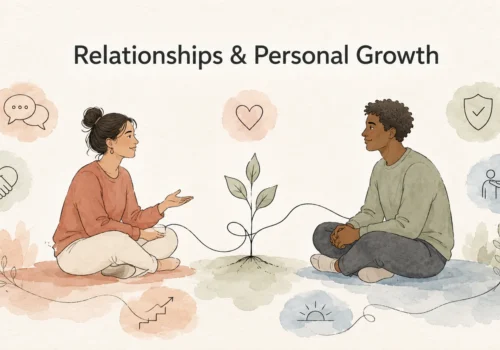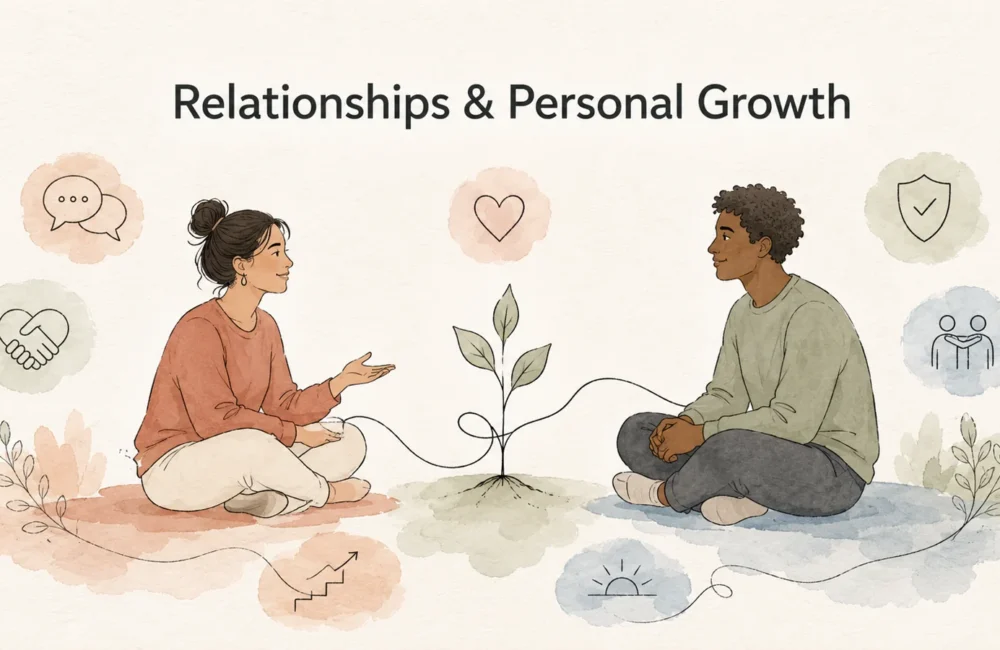

Personal growth is often described as an individual project: set goals, build confidence, change habits, and become more self-aware. In real life, however, much of that development happens in relationship with other people. Family members, friends, romantic partners, mentors, colleagues, and communities can influence what we believe about ourselves, which goals feel possible, how we respond to setbacks, and whether we feel safe enough to explore something new.
The World Health Organization now describes social connection as a major contributor to health and well-being. Its 2025 Commission on Social Connection report emphasizes that the quality, function, and structure of relationships all matter. For personal growth, quality is especially important: being surrounded by people is not the same as being understood, respected, encouraged, or challenged constructively.
Quick answer: Relationships can shape personal growth by influencing self-concept, self-esteem, goal pursuit, emotional regulation, values, habits, and access to new experiences. Research suggests that responsive and practical support can help people make progress toward goals, while negative or controlling support can hinder it. Close partners may also help people move toward their own “ideal self” when they affirm goals the person genuinely values. The healthiest influence supports autonomy and individuality rather than making growth dependent on approval.
Research review updated: September 2, 2026.
Why Relationships Matter for Personal Growth
People develop in social environments. From childhood onward, feedback from others helps shape our expectations about whether we are capable, worthy, trustworthy, welcome, or safe. In adulthood, those processes continue. A partner may encourage a career move. A friend may challenge an unhelpful assumption. A sibling may reinforce an old family role. A mentor may notice a strength before we do.
This does not mean other people determine who we become. Personal growth still depends on our choices, context, resources, opportunities, and individual differences. But relationships can change the conditions in which those choices are made.
The useful question is not whether a relationship changes you; close relationships almost certainly do. The more useful question is whether that influence helps you become more capable, self-directed, connected, and aligned with your values—or gradually makes you smaller, more dependent, or less able to act as yourself.
For related guidance, explore the BeyondPsychHub Relationship hub, which covers trust, boundaries, communication, attachment, conflict, and supportive caregiving.
How Relationships Shape and Influence Personal Growth
1. Relationships influence self-concept
Self-concept is the set of beliefs and perceptions you hold about who you are. Close relationships can reinforce certain parts of that identity through attention, expectations, feedback, and repeated interaction.
For example, a friend who consistently treats you as resourceful may make it easier to notice and use that quality. A relationship that repeatedly labels you as “the difficult one,” “the weak one,” or “the responsible one” may also shape behaviour—especially when the role has existed for years.
This is one reason identity should remain flexible rather than being defined entirely by another person’s opinion. Our guide to self-concept in psychology explains how experience, social feedback, roles, and self-evaluation contribute to the way people understand themselves.
2. Support can strengthen goal pursuit
Close relationships often become part of how goals are pursued. Support can be emotional—encouragement, reassurance, listening—or practical, such as sharing childcare, helping with transport, studying together, or making space for training.
A 2022 multilevel meta-analysis combined 195 effect sizes from 36 samples involving 10,130 adults in romantic relationships. Partner support showed an overall positive association with goal outcomes such as progress, commitment, and self-efficacy (r = .25). Responsive support and practical support were both positively associated with goal outcomes, while negative support was associated with poorer goal pursuit.
The detail matters: support is not the same as taking over. Healthy support expands choice, competence and self-trust rather than making growth conditional on approval.
3. Close partners can affirm the “ideal self”
Relationship researchers use the term Michelangelo phenomenon for a process in which a close partner perceives and behaves toward someone in ways that support the person’s own ideal self—the qualities, values, and goals that person genuinely wants to develop.
Classic studies found that perceived partner affirmation was associated with movement toward the ideal self and with better couple functioning. A newer 2026 study of 452 individuals from 258 couples found that greater partner affirmation was associated with better relationship quality, greater life satisfaction, and lower depression. Movement toward the ideal self statistically helped explain those associations. Because the study was cross-sectional, it cannot prove that partner affirmation caused the outcomes.
Growth-supportive relationships do not sculpt a person into someone else’s preferred version of them. The “ideal” belongs to the person growing. Pressure to become thinner, quieter, more successful, less social, more religious, less ambitious, or otherwise different primarily to satisfy someone else is not the same process.
4. Relationships and self-esteem can influence each other
A large 2020 meta-analysis of longitudinal research found small prospective associations in both directions: better social relationships predicted later self-esteem, and higher self-esteem predicted later relationship quality. The effects were modest, and a later methodological reanalysis questioned whether those cross-lagged associations should be interpreted as direct causal effects.
The safest conclusion is that self-esteem and relationships are intertwined rather than that one simply “causes” the other. A 2024 review in Nature Reviews Psychology similarly argued that self-esteem may influence romantic relationship quality through processes such as trust and reciprocal behaviour rather than through one simple direct pathway.
5. Friendships can expand perspective and belonging
Personal growth does not only happen in romantic relationships. A 2023 systematic review of 38 studies on adult friendship found that friendship quality and socializing with friends were generally associated with greater well-being. Autonomy support, feeling that one matters, friendship maintenance, and supportive responses to good news were among the factors linked with positive outcomes.
The review also identified important limitations: many studies were correlational, some relied heavily on university samples, and evidence was thinner for several aspects of well-being. So friendships should not be romanticized as automatically beneficial. Quality matters more than simply accumulating contacts.
6. Attachment patterns can shape how support is given and received
Attachment research examines patterns of closeness, trust, reassurance, and independence in relationships. In the 2026 Michelangelo study, lower attachment anxiety and avoidance were associated with greater partner affirmation and, indirectly, with better well-being outcomes.
Attachment patterns are not fixed identities or diagnoses. They can vary by relationship and change with experience. If this area is relevant to you, read our guide to the four attachment styles and what they can—and cannot—tell you.
7. Relationships create opportunities to practise boundaries, communication, and repair
Growth often becomes visible in ordinary interactions: saying no without excessive guilt, asking clearly for what you need, listening without immediately becoming defensive, apologizing when you cause harm, or staying present during disagreement without abandoning your values.
These are relational skills, not signs that conflict should disappear. Healthy relationships can contain disagreement while still protecting respect, consent, trust, and individuality. Our article on the five components of a healthy relationship provides a practical framework for evaluating those foundations.
What the Research Says: A Balanced View
| Evidence | Main finding | Important limitation |
|---|---|---|
| WHO Commission on Social Connection, 2025 | Social connection is important for health, well-being, education, work, and resilience | Broad public-health evidence does not tell us how one specific relationship will affect one person |
| Vowels et al., 2022 meta-analysis | Partner support was associated with goal progress, commitment, and self-efficacy; negative support was associated with poorer outcomes | Studies used varied support measures and included romantic relationships |
| Harris & Orth, 2020 meta-analysis | Social relationships and self-esteem showed small reciprocal prospective associations | Later methodological work cautioned against simple causal interpretation |
| Adult friendship systematic review, 2023 | Friendship quality and socializing were generally linked with well-being | Many studies were correlational and some populations were overrepresented |
| Gu, Kumashiro & Arriaga, 2026 | Partner affirmation was associated with ideal-self movement, relationship quality, life satisfaction, and lower depression | Cross-sectional design cannot establish direction of causality |
Healthy Influence vs Growth-Limiting Influence
A relationship can be close and still limit growth. The difference is often visible in how the relationship responds to autonomy, boundaries, goals, success, mistakes, and disagreement.
| Growth-supportive influence | Growth-limiting influence |
|---|---|
| Shows interest in goals you genuinely value | Defines what your goals should be |
| Offers help without taking over | Uses help to create dependence or obligation |
| Allows changing opinions and identities | Keeps you trapped in an old role |
| Can celebrate your success | Belittles, competes with, or sabotages progress |
| Respects boundaries and separate interests | Punishes independence or demands constant access |
| Gives specific, respectful feedback | Uses contempt, humiliation, threats, or chronic criticism |
| Repairs conflict and takes responsibility | Denies harm or makes you responsible for every problem |
A supportive relationship is not one that constantly pushes you to improve; it is one that leaves enough psychological room for you to choose what improvement means.
Learning to protect that room often requires clear limits. See our practical guide to setting healthy boundaries for ways to communicate needs while preserving respect and self-respect.
7 Practical Ways to Build Growth-Supportive Relationships
1. Name your own growth goals first
Before asking another person to support you, clarify what you want and why. “I want to get healthier” is vague. “I want to walk four days a week because I value energy and mobility” gives both you and the other person something concrete to support.
2. Ask for the kind of support you need
Do you want encouragement, practical help, accountability, advice, or simply someone to listen? Unwanted advice can feel controlling even when the intention is good. Support is more useful when it fits the recipient.
3. Protect autonomy on both sides
Growth should not require one person to become the other’s project. Give encouragement without monitoring every decision. Accept that someone can value your support and still choose differently.
4. Build a network, not a single point of dependence
Different relationships can support different parts of life. A friend may understand your creative goals, a colleague may help with career skills, family may provide practical help, and a partner may offer emotional support. A wider network reduces pressure on one relationship to meet every need.
5. Practise curiosity during conflict
Ask what each person is protecting, needing, or assuming before jumping to conclusions. Mindful attention can help slow automatic reactions; our guide to building a mindful relationship offers practical listening and communication strategies.
6. Review whether feedback is helping
Useful feedback is specific, respectful, and connected to behaviour you can change. “You interrupted me three times” is different from “You are selfish.” Ask yourself whether repeated feedback improves clarity and skill—or mainly produces shame and self-doubt.
7. Keep connection and identity in balance
Relationship growth is healthiest when connection and individuality can exist at the same time. Maintain interests, friendships, values, and goals that are genuinely yours. A strong relationship can be part of a meaningful life without becoming the whole identity. If you are reflecting on the larger direction of your life, our guide to purpose in life and how to find it may help.
Common Myths About Relationships and Personal Growth
Myth: The right relationship will automatically make you a better person
A supportive relationship can create favourable conditions for growth, but it cannot do the work for you. Change still involves choices, practice, resources, and sometimes professional support.
Myth: A partner who challenges you is always helping you grow
Challenge can be useful when it is respectful and aligned with your values. Pressure, humiliation, coercion, or constant criticism should not be rebranded as “growth.”
Myth: Personal growth means becoming more independent from everyone
Healthy development can include both autonomy and interdependence. Being able to receive support without surrendering agency is often more realistic than trying to need nobody.
Myth: Relationship problems mean the relationship is blocking growth
All relationships encounter friction. The more informative questions are how conflict is handled, whether safety and respect remain intact, and whether both people can learn and repair.
Myth: Attachment style determines whether a relationship will help you grow
Attachment patterns may influence how people seek and respond to closeness, but they are not fixed destinies. Context, partner behaviour, experience, and deliberate skill-building also matter.
Frequently Asked Questions
Can relationships really change your personality?
Relationships can influence habits, roles, confidence, goals, emotional responses, and how people express traits. Personality also has stable components, so change is usually gradual and shaped by many influences rather than one relationship alone.
How do romantic relationships influence personal growth?
Romantic partners may influence growth through emotional and practical support, goal coordination, feedback, shared experiences, attachment processes, and affirmation of the person’s own ideal self. The direction of influence depends heavily on relationship quality.
Can friendships support personal growth as much as romantic relationships?
Yes. Research on adult friendship links friendship quality, socializing, autonomy support, feeling valued, and supportive responses to positive events with well-being. Different relationships can support different areas of growth.
What is the Michelangelo phenomenon in relationships?
It is a research model describing how close partners may help people move toward their own ideal selves by perceiving and behaving toward them in affirming ways. It does not mean one partner should redesign the other person.
How can I tell whether a relationship supports my growth?
Look for respect for boundaries, room for individuality, interest in goals you genuinely choose, constructive feedback, reciprocal support, and the ability to celebrate each other’s progress without control or sabotage.
Can a difficult relationship still lead to personal growth?
People sometimes learn important lessons after difficult relationships, but harm is not required for growth. It is safer to distinguish growth that happens despite adversity from the idea that mistreatment was necessary or beneficial.
Should I stay in a relationship because it is “teaching me something”?
Learning something from a relationship does not create an obligation to remain in it. Decisions about staying or leaving can involve safety, values, children, finances, health, culture, and many other circumstances. Serious coercion, violence, stalking, or threats require a safety-focused response rather than a growth mindset.
The Bottom Line
Relationships are part of the environment in which personal growth happens. They can widen or narrow perceived possibilities, reinforce or challenge self-beliefs, make goals easier or harder to pursue, and influence whether people feel safe enough to experiment, fail, learn, and try again.
The most growth-supportive relationships do not demand constant self-improvement. They combine connection with autonomy: “I see who you are, I respect what matters to you, and I will support your growth without taking ownership of it.”
Key Takeaways
- Relationships can influence self-concept, self-esteem, goal pursuit, habits, emotional responses, and identity.
- Research links responsive and practical partner support with better goal outcomes, while negative support is associated with poorer outcomes.
- Friends, family, mentors, and communities can shape growth as well as romantic partners.
- Partner affirmation may help people move toward their own ideal self, but the evidence should not be interpreted as proof that every supportive interaction causes growth.
- Healthy influence protects autonomy, boundaries, individuality, and the person’s own values.
- Control, humiliation, isolation, coercion, or sabotage should not be reframed as challenges that are “good for growth.”
- Personal growth and healthy connection can reinforce each other without requiring dependence or perfection.
References
- World Health Organization. From loneliness to social connection: charting a path to healthier societies. Report of the WHO Commission on Social Connection. 2025.
- Vowels LM, Carnelley KB, Stanton SCE. Partner Support and Goal Outcomes: A Multilevel Meta-Analysis and a Methodological Critique. European Journal of Social Psychology. 2022.
- Harris MA, Orth U. The Link Between Self-Esteem and Social Relationships: A Meta-Analysis of Longitudinal Studies. Journal of Personality and Social Psychology. 2020;119(6):1459-1477.
- Lüdtke O, Robitzsch A. Unmasking artifactual links: A reanalysis reveals no direct causal relationship between self-esteem and quality of social relations. Heliyon. 2023.
- Pezirkianidis C, Galanaki E, Raftopoulou G, Moraitou D, Stalikas A. Adult friendship and wellbeing: A systematic review with practical implications. Frontiers in Psychology. 2023;14:1059057.
- Gu Y, Kumashiro M, Arriaga XB. Sculpted by Love: Attachment Security and the Michelangelo Phenomenon. Behavioral Sciences. 2026;16(7):1237.
- Drigotas SM, Rusbult CE, Wieselquist J, Whitton SW. Close Partner as Sculptor of the Ideal Self: Behavioral Affirmation and the Michelangelo Phenomenon. Journal of Personality and Social Psychology. 1999;77(2):293-323.
- Wood JV, Forest AL, Friesen JP, et al. Self-esteem and romantic relationship quality. Nature Reviews Psychology. 2024;3:27-41.