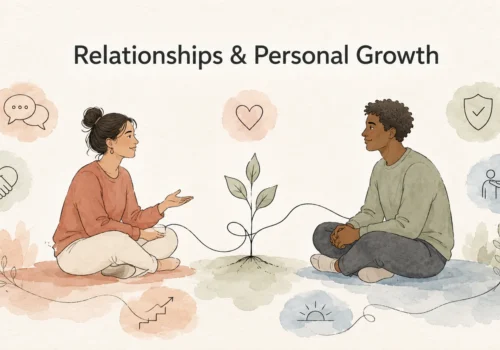

A mindful relationship is not one in which both people stay calm, agree all the time, or never make mistakes. It is a relationship where you notice what is happening inside you and between you, pause before reacting automatically, and choose a response guided by respect, honesty, and care.
These skills can support romantic relationships, friendships, and close family bonds. They can make everyday conversations more intentional, but they are not a cure for serious conflict, incompatibility, or abuse. Recent research suggests that mindfulness may help relationship satisfaction a little; the evidence is promising, but it is not yet strong enough for guaranteed claims.
How Do You Build a Mindful Relationship?
Start by creating brief moments of undivided attention, noticing your emotional reactions, listening to understand, speaking clearly, repairing disconnection, and caring for your own well-being. You do not need to meditate together or follow a perfect routine. Small habits repeated consistently are more useful than one intense conversation.
- Give the other person your attention.
- Pause before turning assumptions into facts.
- Reflect what you heard before offering advice.
- Express feelings, needs, and boundaries directly.
- Repair mistakes and notice what is going well.
- Maintain sleep, support, interests, and time apart.
What Is Mindfulness in a Relationship?
Mindfulness means paying attention to present-moment experience with openness and less automatic judgment. In a relationship, that attention includes your thoughts, emotions, body sensations, impulses, tone of voice, and the other person’s words and nonverbal signals. Our guide to what mindfulness is and how it works explains the basic practice in more detail.
Relationship mindfulness does not mean suppressing anger, accepting every behavior, or analyzing your partner. It means recognizing, for example, “My chest is tight, I feel defensive, and I want to interrupt,” then deciding whether to listen, ask a question, set a boundary, or take a respectful pause.
What Does Recent Research Say?
| Research finding | What it means in daily life |
|---|---|
| A 2025 systematic review and meta-analysis of 28 randomized studies found a small positive effect of mindfulness interventions on couple relationship satisfaction, but rated the certainty of evidence as very low. | Mindfulness may help, but it should be presented as a supportive skill—not a proven way to fix a relationship. |
| A 2025 scoping review found promising links between relationship-specific mindfulness and well-being, but most studies were cross-sectional, used varied definitions, and came from the Global North. | An association does not prove that mindfulness caused the better outcome, and findings may not apply equally to every culture or relationship. |
| A 2024 daily-diary study of new parents found that on days when a person was more mindful with their partner than usual, both partners tended to report greater relationship satisfaction. | Brief, day-to-day moments of attention may matter, although observational diary data cannot prove cause and effect. |
| Across five studies involving 1,624 people, high-quality listening was linked with greater well-being and connection even during disagreement. | How you listen can matter as much as whether you agree. |
Evidence note: The research supports cautious optimism, not certainty. Relationship quality also depends on safety, compatibility, health, stress, finances, caregiving, discrimination, and many other factors that mindfulness alone cannot change.
6 Evidence-Informed Tips for a More Mindful Relationship
1. Make Presence Small and Specific
“Be present” can feel vague. Turn it into a behavior you can see: put the phone out of reach for ten minutes, face the person, and notice when your attention wanders. A 2026 systematic review of 22 studies found that phone-based snubbing, often called phubbing, was associated with lower intimacy, trust, responsiveness, and relationship satisfaction across social settings. Much of that evidence is observational, but a device-free check-in is a low-risk experiment.
Try this 60-second reset before an important conversation:
- Feel both feet on the floor.
- Take one slower breath without forcing it.
- Name your main emotion silently.
- Set one intention: “I want to understand,” or “I want to be honest and kind.”
2. Pause Before You Interpret or React
During stress, the mind fills gaps quickly: “They are late because they do not care,” or “They disagree because they do not respect me.” A mindful pause separates an observation from the story attached to it.
Use three questions: What do I know? What am I assuming? What could I ask? Replace “You never think about me” with “When the plan changed and I did not hear from you, I felt worried and unimportant. What happened?” This does not require you to dismiss patterns or tolerate harm. It helps you gather clearer information before deciding what the behavior means.
If either person is too activated to speak respectfully, agree on a pause and a specific return time. A pause is different from silent punishment because it includes reassurance and follow-through. For more tools, read our guide to relationship conflict resolution.
3. Listen for Understanding Before Solving
High-quality listening communicates attention, understanding, and positive intention. It does not require agreement. Recent research suggests that feeling well listened to can support connection and well-being even when people hold opposing views.
Use this simple sequence:
- Reflect: “It sounds as though the change left you feeling overlooked.”
- Check: “Did I understand that correctly?”
- Ask: “Would you like comfort, help solving it, or just a chance to be heard?”
Avoid preparing your defense while the other person speaks. Also avoid forced eye contact, taking notes without permission, or repeating words mechanically. Good listening should feel responsive, not like an interview. Building empathy can help you recognize another person’s experience without losing your own viewpoint.
4. Communicate Feelings, Needs, and Boundaries Clearly
Mindful communication is honest and specific. Instead of expecting someone to read your mind, describe the situation, your feeling, and a workable request: “I feel disconnected when we talk while answering messages. Could we have fifteen phone-free minutes after dinner?” A request leaves room for discussion; a demand uses pressure or punishment.
Boundaries describe what you will do to protect your well-being. For example: “I want to continue this conversation, but I will step away if either of us starts shouting. I can try again at 7 p.m.” Boundaries are not threats, and mindfulness does not require endless availability. If fear and uncertainty repeatedly dominate the relationship, our article on relationship anxiety may help you separate internal worries from problems that need action.
5. Practice Repair and Specific Appreciation
Every close relationship includes missed cues, sharp words, and misunderstandings. A repair attempt is a small action that tries to restore safety and connection: “That came out harshly. Let me start again,” or “I understand why that hurt.” A useful apology names the behavior, acknowledges its impact, avoids excuses, and states what will change.
Also notice ordinary contributions. Say what you appreciated and why: “Thank you for checking in before my appointment; I felt supported.” Studies link expressed and perceived gratitude with relationship maintenance and satisfaction, but appreciation should never be used to cover unresolved harm or silence a valid complaint.
When a breach has damaged confidence, mindfulness can support careful conversations, but rebuilding trust in a relationship also requires consistent, observable behavior over time.
6. Care for Yourself and Protect Healthy Interdependence
A mindful relationship includes two people with separate bodies, histories, limits, and needs. Sleep, movement, food, friendships, privacy, interests, and time alone can affect how much emotional capacity you bring to a conversation. Self-care does not excuse unkind behavior, but chronic depletion can make patience and regulation harder.
Check in with yourself: “What am I feeling? What do I need? Is this mine to manage, ours to discuss, or something that needs outside help?” Maintain support beyond the relationship rather than asking one person to meet every emotional need. Our evidence-informed guide to self-care offers practical ways to build that foundation.
A 7-Day Mindful Relationship Practice
- Day 1: Have a ten-minute, phone-free check-in.
- Day 2: Notice one trigger and write the fact, your interpretation, and a curious question.
- Day 3: Reflect back what you heard before replying.
- Day 4: Make one clear request instead of hinting.
- Day 5: Express one specific appreciation.
- Day 6: Discuss one boundary or need calmly.
- Day 7: Review what helped, what felt forced, and what to adjust.
Do not score each other. The purpose is awareness and learning, not perfect performance.
Common Myths About Mindful Relationships
Myth: Mindful couples do not argue
Fact: Disagreement is normal. Mindfulness may help people notice escalation and respond more deliberately, but the goal is respectful conflict, not zero conflict.
Myth: Being nonjudgmental means accepting everything
Fact: You can observe a situation clearly and still decide that a behavior is unsafe, dishonest, or incompatible with your values.
Myth: Meditation alone will repair trust
Fact: Repair also requires accountability, changed behavior, consent, and time. Some problems need professional support.
Myth: One person can mindfully fix the whole relationship
Fact: One person can change their own behavior and boundaries, but mutual respect and safety require participation from everyone involved.
When to Seek Professional or Safety Support
Consider a qualified relationship therapist when the same conflict repeats without repair, communication routinely shuts down, trust has been seriously damaged, or mental health symptoms are affecting the relationship. Our overview of relationship counseling explains common approaches and what to expect.
Mindfulness is not a safety plan. Threats, stalking, coercive control, forced sexual activity, intimidation, and physical violence are not communication problems. If you feel unsafe, prioritize confidential individual support and local emergency or domestic-violence services. Review these warning signs of an unhealthy relationship. The World Health Organization identifies psychological abuse, controlling behaviors, sexual coercion, and physical aggression as forms of intimate partner violence.
Frequently Asked Questions
What does a mindful relationship mean?
It means bringing present-moment attention, curiosity, honesty, and less automatic judgment to interactions while maintaining respect and healthy boundaries.
Can mindfulness improve relationship satisfaction?
Possibly. A 2025 meta-analysis found a small positive effect, but the certainty of evidence was very low. Mindfulness should be treated as a supportive practice, not a guaranteed relationship treatment.
Do both partners need to meditate?
No. Many relationship-mindfulness skills—pausing, listening, naming emotions, and making clear requests—do not require formal meditation. Mutual participation helps, but each person can begin with their own behavior.
How can I stay mindful during an argument?
Notice early physical signs of escalation, slow your pace, focus on one issue, and reflect what you heard. If respectful conversation is no longer possible, take a time-limited break and agree when to return.
How long does it take to build a mindful relationship?
There is no fixed timeline. Look for gradual changes in attention, clarity, repair, and consistency over weeks and months rather than expecting an immediate transformation.
Can mindfulness fix an unhealthy or abusive relationship?
No. Mindfulness cannot make coercion, intimidation, or violence safe. Seek confidential professional and safety support when abuse is present.
Key Takeaways
- A mindful relationship is based on attention, clear communication, respect, and boundaries—not constant calm.
- Current research suggests a small possible benefit for relationship satisfaction, but the evidence remains uncertain.
- Practice presence, pause before reacting, listen reflectively, make clear requests, repair mistakes, and care for yourself.
- Mindfulness cannot replace accountability, counseling when needed, or safety support when abuse is present.
References
- Voldstad A, et al. (2025). The effect of mindfulness interventions on couple relationship satisfaction: A systematic review and meta-analysis. Journal of Consulting and Clinical Psychology.
- Varghese A, Alfonso T. (2025). A scoping review of relationship-specific mindfulness and factors influencing relational well-being.
- Morin L, et al. (2024). A multilevel diary and dyadic study exploring the link between new parents’ mindfulness and relationship satisfaction. Mindfulness.
- Saluk D, et al. (2026). Listening across the divide: High-quality listening promotes speakers’ state well-being during disagreements. Journal of Personality and Social Psychology.
- Jakhar M, et al. (2026). Digital disconnection: A systematic review of phubbing behavior. Acta Psychologica.
- Le BM, et al. (2019). Can I tell you how I feel? Perceived partner responsiveness encourages emotional expression.
- Neff KD, et al. (2022). Self-compassion and current close interpersonal relationships: A scoping literature review.
- World Health Organization. (2026). Violence against women: Fact sheet.