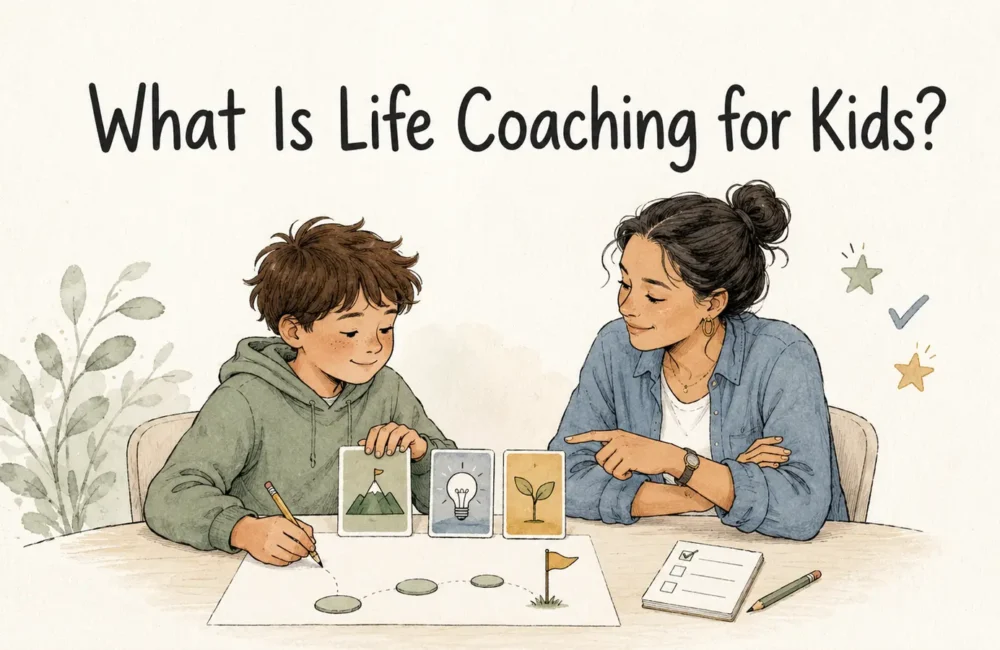

Life coaching for kids is a structured, non-clinical process that helps a child choose a practical goal, explore options, take an age-appropriate next step, and learn from the result with a supportive adult. It can be used for everyday development goals such as building routines, following through on plans, communicating clearly, handling a transition, or working toward a personal project.
The emphasis is on coaching: the child has a voice, the coach asks useful questions, and progress is built through small experiments. A coach should not diagnose a child, treat a condition, or promise to “fix” a personality or guarantee grades, confidence, or success.
Advertising and partnership disclosure: At publication, this article contains no paid recommendation or sponsored product placement. Beyond Psychub may consider clearly labelled collaborations with responsible child-development, coaching-education, safeguarding, educational-planning, or family-learning organizations. Commercial partners do not control the evidence, rankings, safety criteria, or editorial conclusions.
Educational note: This guide covers non-clinical coaching for everyday skills and goals. Coaching is not a substitute for medical care, psychological assessment, psychotherapy, crisis support, special-education evaluation, or safeguarding action. If a child may be unsafe, is in severe or persistent distress, or has a major change in daily functioning, contact an appropriately qualified local professional or emergency service.
Key Takeaways
- Kids’ life coaching is future-focused and practical: clarify a goal, choose a small action, review it, and adjust.
- The best goals are developmentally appropriate, meaningful to the child, and supported—not controlled—by adults.
- A 2025 review found promising outcomes across adolescent coaching studies, but the field remains small and varied. Research is especially limited for younger children and commercial one-to-one services.
- Evidence for individual techniques is stronger. A 2026 meta-analysis found that simple “if–then” plans had a small-to-medium effect on children’s goal achievement.
- A coaching credential can be useful, but parents should also verify child-specific training, safeguarding procedures, background checks appropriate to their location, confidentiality rules, and clear scope.
What Is Life Coaching for Kids?
Life coaching for kids adapts the collaborative structure of adult coaching to a child’s age, language, attention span, interests, and level of independence. The coach does not hand the child a ready-made life plan. Instead, the coach helps the child describe what matters, notice strengths and obstacles, generate options, choose a manageable step, and reflect without shame when a plan needs to change.
The International Coaching Federation (ICF) defines coaching as partnering with clients in a thought-provoking and creative process that supports their potential. For a minor, there is also a parent, guardian, school, or other sponsor. That makes the agreement more complex: the child should know what is private, what the paying adult will be told, and when safety or law requires information to be shared. The ICF Code of Ethics, effective April 1, 2025, requires coaches to explain the nature of coaching and agree on roles, responsibilities, confidentiality, and financial arrangements before coaching begins.
There is no single evidence-based minimum age for life coaching. Readiness matters more than a marketing label. A younger child may work through drawing, games, visual choices, short practice tasks, and closer parent involvement. An adolescent may be ready for more privacy, self-reflection, and independent action planning. In either case, participation should be understandable and voluntary; a child’s reluctance is information to explore, not resistance to overpower.
What Does a Kids’ Life Coach Do?
A kids’ life coach turns a broad wish—“I want to be more organized” or “I want to speak up”—into a child-owned learning process. Depending on training and scope, coaching may focus on:
- Clarifying a personal, school, sport, creative, friendship, or routine-based goal
- Breaking a goal into realistic steps and deciding what “done” looks like
- Practising planning, decision-making, communication, and follow-through
- Using reminders, visual trackers, check-ins, and simple “if–then” plans
- Reviewing setbacks as feedback rather than as proof that the child has failed
- Recognizing effort and learning how to celebrate wins without making praise dependent on perfect results
A coach might use a simple structure such as the GROW coaching model: define the Goal, describe the current Reality, explore Options, and agree on the Way forward. With children, each stage should be concrete, brief, and flexible.
What Does the Research Say About Life Coaching for Kids?
The honest answer is promising but preliminary. Direct research on branded, commercial life coaching for children is limited. More evidence comes from educational coaching, school-based goal programs, and studies of the specific self-regulation tools that a competent coach may use. Those related findings support a sensible process, but they do not prove that every kids’ coaching service is effective.
| Evidence | What it found | What parents should remember |
|---|---|---|
| 2025 systematic review 28 publications on secondary-school coaching | Reported significant findings across personal, social, emotional, cognitive, and moral development. Frequently studied outcomes included perceived competence, motivation, relationships, conflict resolution, and well-being. | Programs, delivery formats, duration, and outcomes varied. The review concerns adolescents in educational settings, not all ages or commercial services. |
| 2022 randomized wait-list study 43 students in Grades 4–7 | A small-group goal-setting curriculum was associated with higher teacher-rated motivation, self-knowledge, self-direction, and relationship skills, with a large reported effect. | Only two schools and 43 students were involved. Counselor trainees delivered a school curriculum, so it is not a direct test of private life coaching. |
| Life-coaching trial 56 female students, mean age 16 | Ten individual teacher-coach sessions over two school terms were associated with greater hope and cognitive hardiness than a wait-list condition. | The sample was small, all female, and from one setting; the comparison was a wait-list, and the study is older. |
| 2026 meta-analysis of “if–then” plans 42 studies, 12,957 children | Implementation intentions—plans such as “If X happens, then I will do Y”—had a small-to-medium overall effect on goal achievement (Hedges’ g = 0.31). | This supports one practical planning technique, not life coaching as a complete service. Effects varied substantially between studies. |
The newest broad review, published in 2025 in the International Journal of Mentoring and Coaching in Education, included 28 publications on coaching for secondary-school adolescents and identified 45 outcome dimensions. Results depended partly on duration and whether coaching was individual, group-based, or mixed. That breadth is encouraging, but it also shows why one simple effect size for “kids’ coaching” is not yet available.
For younger students, a 2022 randomized wait-list study of the True Goals curriculum involved 43 students in Grades 4–7 across two schools. The treatment group received higher teacher ratings on several developmental skills. In 2024, the U.S. What Works Clearinghouse judged this single study to meet its evidence standards without reservations because it was randomized and had low attrition. Its own notice is equally important: a single-study review does not represent the full evidence base.
A useful 2026 update concerns a technique that fits coaching well. A registered systematic review and meta-analysis of implementation intentions combined 52 effect sizes from 42 studies and 12,957 children. The average effect on goal achievement was small to medium, but heterogeneity was high; when seven outlying studies were removed, the estimate fell from g = 0.31 to g = 0.18. In practical terms, “If it is 6:30 p.m., then I will put my sports kit by the door” is more testable than “I will be responsible.” It is still one tool, not a guarantee.
These results support cautious optimism. They also support good editorial skepticism: testimonials, before-and-after stories, or a coach’s own survey cannot replace independent studies. Parents should look for measurable goals, proportionate claims, and willingness to say when coaching is outside the coach’s scope.
What Happens in a Life-Coaching Session for a Child?
Sessions vary, but a transparent coaching process commonly follows seven steps:
- Agree on roles and safety. The coach, child, and parent discuss the purpose, privacy boundaries, records, fees, communication, and reasons information may need to be shared.
- Choose the child’s goal. The adult may describe a concern, but the goal is translated into language the child understands and can influence. A goal-readiness check can prevent adults from pushing a goal the child does not own.
- Define a small success. “Pack my bag on three school nights” is clearer than “be more organized.” See this guide to setting personal goals.
- Explore strengths and obstacles. The coach asks what has worked before, what might get in the way, and what support is available.
- Choose one action. The child selects a manageable experiment, sometimes using a visual tracker, reminder, role-play, or if–then plan.
- Review without judgment. At the next meeting, the coach asks what happened, what the child learned, and what to change. This keeps the emphasis on progress over perfection.
- Share an agreed parent update. Parents receive useful process information while the child retains the appropriate privacy promised in the three-way agreement.
How Is Kids’ Life Coaching Different From Tutoring, Mentoring, and Therapy?
The services can complement one another, but the labels should not be blurred. A provider may hold more than one qualification; when that happens, ask which role they are using in each session.
A coach can help a child plan a homework routine; a tutor teaches the mathematics; a mentor may share experience about adjusting to a new school; and a clinician assesses or treats a health or psychological concern. Calling clinical treatment “coaching” does not remove the need for clinical qualifications.
When Might Life Coaching Be a Good Fit for a Child?
Coaching may be worth considering when the child is generally able to participate in everyday activities and has a specific developmental goal that falls within the coach’s competence. Examples include:
- Creating a consistent morning, homework, practice, or bedtime preparation routine
- Planning a personal project, performance, competition, or school transition
- Practising assertive communication, asking for help, or preparing for a difficult conversation
- Learning to set priorities, estimate time, and review what worked
- Building skill-based self-confidence through preparation and repeated action
- Developing everyday self-regulation skills such as pausing, planning, monitoring, and adjusting
Coaching is less likely to help when it is imposed as punishment, the goal belongs only to the parent, or the provider is being asked to work outside a non-clinical scope. Severe distress, suspected abuse, self-harm, threats of harm, disordered eating, substance use, a marked loss of functioning, or a sudden major change in sleep, behavior, or school attendance calls for appropriate assessment, safeguarding, or emergency support—not coaching alone.
How to Choose a Safe, Qualified Life Coach for Kids
A coaching title by itself does not tell you enough. Training standards and legal requirements vary by country and region, so verify claims rather than relying on badges or testimonials.
- Verify coaching education and credential status. If a coach claims an ICF credential, use the organization’s public verification directory. Also ask what child- or adolescent-specific education they completed.
- Ask for safeguarding evidence. Look for recent child-protection training, a written safeguarding policy, a named reporting route, and background screening appropriate to your jurisdiction and setting.
- Read the three-way agreement. It should define the child as the coaching client, the parent or organization as sponsor where relevant, and the limits of confidentiality in plain language.
- Check scope and referral boundaries. A responsible coach explains what they do not do and has a process for pausing coaching and referring concerns appropriately.
- Review privacy and technology. Ask how notes, recordings, messages, scheduling data, and video-session information are stored, who can access them, and when they are deleted.
- Assess the child’s experience. A good introductory session should leave the child feeling respected, able to disagree, and clear about what will happen next.
- Agree on review points. Decide in advance how progress, fit, cost, and the option to stop will be reviewed. Effective coaching should not create indefinite dependence.
For online coaching, safeguarding still applies. The UK’s NSPCC guidance for lone workers recommends a suitable visible setting, a common rather than private space for the child, a parent or carer within earshot, and a record after the session. Local rules may differ, but the underlying questions—visibility, professional boundaries, consent, privacy, and record-keeping—are useful anywhere.
Questions to ask before paying
- What coaching qualification do you hold, and how can I verify it?
- What training and supervised experience do you have with this age group?
- How will my child help choose the goal?
- What will remain private, what will you tell me, and what are the safety exceptions?
- What is your safeguarding and concern-reporting process?
- How do you measure progress without pressuring the child?
- When would you say coaching is not appropriate or should stop?
- What are the fees, cancellation terms, data-retention policy, and complaint route?
Red Flags Parents Should Not Ignore
- Claims to cure anxiety, ADHD, trauma, depression, or another condition through life coaching
- Guaranteed grades, confidence, friendships, sports results, or personality change
- Pressure to stop prescribed care, avoid qualified professionals, or distrust every teacher or family member
- A demand for secrecy rather than a clear, age-appropriate confidentiality agreement
- No safeguarding policy, screening evidence, complaint process, or plan for responding to a concern
- Humiliation, coercion, intense confrontation, unwanted physical contact, or using exercise or food as punishment
- Private messaging at inappropriate times, blurred personal relationships, or sessions in hidden locations
- Heavy pressure to buy long packages, recruit other families, or purchase unvalidated tests, supplements, or surveillance tools
The Parent’s Role: Sponsor, Supporter, Not Director
Parents usually pay, arrange transport or technology, and reinforce practice at home. That influence is valuable, but it can also turn coaching into another performance demand. The healthier role is to create conditions for learning while leaving appropriate choices with the child.
- Use open parent–child communication: “What support would help?” rather than “Did the coach make you finish it?”
- Praise preparation, honest reflection, and course correction—not only outcomes.
- Protect the privacy that was promised while staying available for safety concerns.
- Avoid interrogating the child after each session or using coach updates as evidence in family conflict.
- Revisit fit regularly and let the child say when the relationship is not helping.
Partnership and Advertising Opportunities
This topic offers a responsible commercial fit for organizations that help families verify quality or practise non-clinical skills. Potential collaborations may include independently credentialed child- and youth-coaching programs, coach-education providers with robust safeguarding content, background-check or credential-verification services, age-appropriate goal journals, and privacy-conscious educational planning tools.
Beyond Psychub should decline partnerships that promise cures or guaranteed outcomes, disguise advertising as research, encourage surveillance or secrecy, sell supplements as a coaching solution, or ask sponsors to influence safety guidance. Any paid placement should be labelled at the point of promotion, distinguish advertisement from endorsement, use appropriate sponsored-link attributes, and preserve independent editorial review. Suitable organizations can review the site’s collaboration and contribution information.
Frequently Asked Questions
What age is appropriate for life coaching for kids?
There is no universal research-based minimum age. A child needs to understand the process, express some preferences, and participate without coercion. Younger children generally need shorter, more visual sessions and closer parent involvement; adolescents may be ready for more independence and privacy.
How long should kids’ life coaching last?
There is no evidence-based session count that fits every child. Use a time-limited initial agreement with a specific goal and review point—for example, after several sessions—rather than buying an open-ended package. Continue only if the child is engaged, the coach remains within scope, and there is observable learning or progress.
Do parents attend coaching sessions?
Often parents join the beginning of the first session to agree on goals, privacy, and safeguarding, then receive brief updates at agreed intervals. The exact arrangement should reflect the child’s age, local rules, safety, and the written coaching agreement.
Can a kids’ life coach guarantee better grades or confidence?
No. A coach can help a child practise planning, communication, preparation, and review, but outcomes also depend on the child’s circumstances, learning needs, relationships, opportunities, and time. Guarantees are a red flag.
Is life coaching the same as tutoring?
No. Tutoring teaches academic content or subject-specific skills. Coaching helps a child define a goal, make a plan, act, and reflect. A child may benefit from both, but the provider should be clear about which role they are performing.
What should confidentiality look like with a minor?
The child, coach, and parent or sponsor should agree before sessions begin on what stays private, what progress information is shared, how records are handled, and what safety or legal exceptions apply. “Everything is secret” and “the parent hears everything” are both poor substitutes for a clear, age-appropriate agreement.
The Bottom Line
Life coaching for kids can offer a useful structure for everyday growth when it is child-centered, goal-specific, time-limited, and safe. Current research is encouraging, particularly for educational coaching and practical tools such as small goals, monitoring, reflection, and if–then plans. It is not strong enough to justify universal claims or guaranteed outcomes.
The quality of the relationship and the safeguards around it matter as much as the method. Choose a coach who respects the child’s agency, explains boundaries, verifies training, welcomes scrutiny, measures progress honestly, and knows when coaching is not the right service.
Sources
- Celaya I, Cueto JA, Balaguer A, Ugarte C. Coaching for secondary school adolescents: a systematic literature review. International Journal of Mentoring and Coaching in Education. 2025;14(3):345–364.
- Martin I, Choi J, Zyromski B, et al. Small-Group Investigation of the True Goals Curriculum With Elementary and Middle School Students: A Randomized Control Study. Professional School Counseling. 2022;26(1).
- U.S. Institute of Education Sciences, What Works Clearinghouse. Single Study Review: True Goals Curriculum. Reviewed October 2024.
- Green S, Grant AM, Rynsaardt J. Evidence-based life coaching for senior high school students: Building hardiness and hope. International Coaching Psychology Review. 2007;2(1):24–32.
- Breitwieser J, Reinelt T. The effectiveness of implementation intentions in children: A systematic review and meta-analysis. British Journal of Psychology. Published online March 5, 2026. doi:10.1111/bjop.70065.
- International Coaching Federation. ICF Code of Ethics. Effective April 1, 2025.
- NSPCC Learning. Safeguarding children for lone workers. Accessed August 21, 2026.
Last reviewed: August 21, 2026. Evidence was checked against the linked research and professional guidance available on that date.