
Self-confidence is not the absence of fear, and it is not a guarantee of success. A more useful definition is trust in your ability to handle a particular situation, take useful action, learn, and adapt—even when the outcome is uncertain.
That distinction matters because popular advice often treats confidence as a personality trait that you either have or do not have. Psychological research is more nuanced. Confidence can be general or situation-specific, and related concepts such as self-esteem and self-efficacy are not interchangeable. More confidence is not automatically better if it becomes disconnected from evidence or skill.
This guide explains what self-confidence means, what research does—and does not—show about it, and 10 practical ways to build confidence without relying on exaggerated affirmations or “fake it until you make it” promises.
What Is Self-Confidence?
In everyday language, self-confidence describes the degree to which you trust your abilities, judgment, or capacity to respond effectively. Research has also distinguished between general self-confidence and confidence in a specific domain. You may feel confident managing a team but uncertain when learning a new technical skill.
Psychology often uses the more precise term self-efficacy for a person’s belief that they can organize and carry out the actions needed for a particular task or challenge. Self-efficacy is therefore often described as task-specific confidence.
Self-Confidence vs. Self-Esteem vs. Self-Efficacy
| Concept | Simple meaning | Example |
|---|---|---|
| Self-confidence | Trust in your ability or judgment, either generally or in a particular area. | “I can handle this presentation even if I feel nervous.” |
| Self-efficacy | Belief that you can perform the actions required for a specific task. | “I can prepare, practise, and deliver a 10-minute presentation.” |
| Self-esteem | Your broader sense of personal worth and value. | “A poor presentation would be disappointing, but it would not make me worthless.” |
These concepts can influence one another, but they are not the same. Someone can have healthy self-esteem while feeling unconfident in a new role. Another person can feel highly confident in one skill while still struggling with broader self-worth.
Why Does Self-Confidence Matter?
Confidence can influence whether you start a task, how much effort you invest, whether you persist after setbacks, and how willing you are to seek new experiences. However, it is important not to turn this into a simple “confidence causes success” formula.
A 2024 systematic review examining self-efficacy and objectively assessed nursing skills found that most included studies reported weak or no correlation between self-efficacy and skill performance. That does not mean confidence is unimportant. It means feeling capable and actually being skilled are related imperfectly. The most useful confidence is therefore calibrated confidence: enough belief to act, combined with enough realism to practise, prepare, ask for feedback, and recognize limits.
Healthy self-confidence often looks less dramatic than people expect. It can include saying, “I do not know yet, but I can learn.”
What Does Healthy Self-Confidence Look Like?
A self-confident person does not need to be loud, outgoing, fearless, or certain. Healthy confidence may show up as the ability to:
- take action without needing complete certainty;
- recognize strengths without denying weaknesses;
- ask questions or request help when needed;
- accept useful feedback without treating it as a verdict on personal worth;
- say no or set a boundary respectfully;
- recover after mistakes instead of giving up;
- prepare for difficult tasks rather than relying on confidence alone;
- change your mind when new evidence appears; and
- distinguish “I am inexperienced” from “I am incapable.”
If self-doubt is your main difficulty, our guide to self-doubt and confidence explores common patterns in more detail.
What Can Lower Self-Confidence?
Confidence can change across situations and life stages. Common influences include:
- being new to a task or role;
- repeated setbacks without useful feedback;
- harsh criticism, bullying, discrimination, or controlling relationships;
- perfectionistic standards that make ordinary mistakes feel unacceptable;
- frequent comparison with highly curated versions of other people’s lives;
- avoiding challenges for long periods, which limits opportunities to gather new evidence of capability;
- chronic stress, poor sleep, exhaustion, or physical illness; and
- mental-health difficulties that affect motivation, concentration, self-appraisal, or social functioning.
Low confidence is not itself a diagnosis. It can occur without a mental-health disorder, and it can also appear alongside conditions such as anxiety or depression. The direction of the relationship may be complex, so it is inaccurate to say that low confidence simply “causes” these conditions.
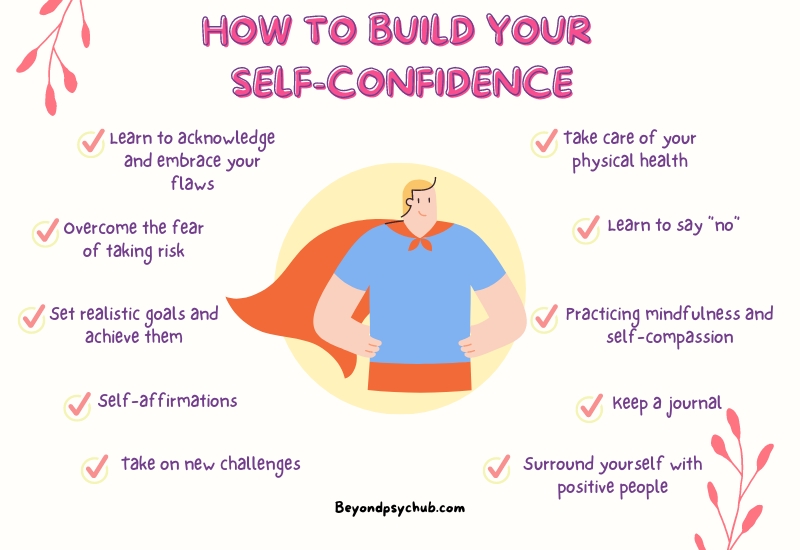
10 Evidence-Informed Ways to Build Self-Confidence
No single technique has been shown to raise confidence for everyone. The strongest practical approach is usually to combine realistic thinking with mastery experiences, skill development, feedback, supportive relationships, and repeated action.
1. Build Confidence From Small Mastery Experiences
Confidence becomes more believable when it is linked to something you have actually done. Choose a challenge that is meaningful but manageable, complete it, and record the evidence.
Instead of “become confident at public speaking,” try:
- prepare a two-minute explanation;
- practise it aloud three times;
- deliver it to one supportive person;
- ask for one specific piece of feedback; and
- increase the difficulty gradually.
In a 2024 systematic review of insufficiently active adults, goal-setting interventions produced a small positive effect on physical activity, while psychological outcomes such as self-efficacy showed smaller and less consistent changes. Use goals as a way to create evidence of progress, not as a test of your worth. Our guide to setting personal goals can help you structure the next step.
2. Practise the Skill, Not Just the Feeling
If you want more confidence in interviews, difficult conversations, leadership, study, sport, or another skill, identify the behaviour that needs practice. Confidence without preparation can become overconfidence; preparation without any willingness to act can become endless avoidance.
Use a simple evidence log:
- What did I practise?
- What went better than last time?
- What needs more work?
- What is my next practice step?
This keeps confidence connected to learning rather than mood.
3. Use Graded Challenges Instead of One Huge Leap
“Get out of your comfort zone” is incomplete advice. A challenge should stretch you without being unnecessarily risky or overwhelming. Build a ladder from easier to harder actions and move upward as your skill and tolerance improve.
For example, if networking feels intimidating, you might start by introducing yourself to one person, then asking one prepared question, then attending a small event, and later taking on a more visible role.
The goal is not to eliminate discomfort before acting. It is to learn that discomfort can be present while you still act effectively.
4. Replace Global Self-Criticism With Accurate Self-Talk
There is an important difference between realistic supportive self-talk and statements you do not believe. Instead of “I am amazing at everything,” try language that is specific and testable:
- “I am nervous because this matters, not because I am incapable.”
- “I have handled difficult learning before.”
- “I can prepare for the parts that are within my control.”
- “One mistake will give me information for the next attempt.”
This approach avoids turning confidence into forced positivity. It is often more useful to challenge an unfair conclusion than to replace it with an equally unrealistic positive one.
5. Use Self-Affirmation Correctly: Start With Values
Popular “affirmations” often involve repeating phrases such as “I am completely confident.” Scientific self-affirmation research usually means something different: reflecting on personally important values, qualities, relationships, or sources of meaning.
A 2025 meta-analysis of 67 published articles found small but significant positive effects of self-affirmation interventions on self-perception and several aspects of well-being. This supports self-affirmation as a useful component of a broader approach—not as proof that repeating positive statements can reprogram the brain or guarantee confidence.
Try: “Which value do I want to express in this situation—courage, learning, honesty, contribution, or respect? What action would show that value?”
6. Reduce Perfectionistic Concerns
Confidence becomes fragile when your self-worth depends on performing perfectly. A 2024 systematic review and meta-analysis involving more than 32,000 adults found a moderate negative association between perfectionistic concerns and self-esteem.
Before a challenging task, define three standards:
- Minimum acceptable: what must be completed?
- Good enough: what would represent solid work?
- Excellent: what is optional if time and energy allow?
This makes room for competence without demanding flawless performance. See our guide to progress over perfectionism for more strategies.
7. Practise Self-Compassion After Setbacks
Self-compassion does not mean ignoring mistakes. It means responding to difficulty without unnecessary humiliation or self-attack. A 2023 meta-analysis of 76 studies found that self-compassion and self-esteem were strongly related, while each also showed distinct relationships with well-being and psychological problems.
After a setback, ask:
- What happened, without exaggerating it?
- What part was within my control?
- What would I say to someone I respect in the same situation?
- What is the next useful action?
Mindfulness can help you notice self-critical thoughts without automatically accepting them as facts. The RAIN mindfulness technique offers one structured way to pause and respond more deliberately.
8. Set Boundaries and Practise Assertive Communication
Confidence can grow when your behaviour becomes more consistent with your values and limits. Practise small forms of assertiveness: asking for clarification, requesting time to decide, expressing a different opinion respectfully, or saying no when a commitment is unrealistic.
A boundary does not require aggression. A simple response such as, “I cannot take that on this week, but I can discuss it next Monday,” can be both respectful and clear.
9. Support the Physical Conditions That Make Action Easier
Sleep, movement, nutrition, illness, pain, and chronic stress can affect concentration, mood, energy, and how difficult a task feels. Physical activity has shown positive effects on several self-perception outcomes in particular populations, but it should not be advertised as a direct or guaranteed treatment for low confidence.
Use health-supporting habits as a foundation: move regularly in ways that suit your health and ability, protect sleep where possible, eat regularly, and seek medical advice for persistent fatigue or physical symptoms. The aim is to create enough capacity to practise the behaviours that matter.
10. Choose Feedback and Relationships That Help You Learn
Supportive people do more than tell you that you are wonderful. Useful support may include encouragement, honest feedback, modelling, mentoring, accountability, and opportunities to practise.
Look for people who can say both, “You can learn this,” and, “Here is what would make your next attempt stronger.” Be cautious about relationships that repeatedly use humiliation, manipulation, or impossible standards as “motivation.”
Common Myths About Self-Confidence
Myth 1: Confident people do not feel nervous
Nervousness and confidence can exist together. Confidence is often the belief that you can respond effectively despite discomfort.
Myth 2: More confidence is always better
Not necessarily. Confidence that greatly exceeds skill can contribute to poor decisions. The goal is confidence that is realistic enough to support action and learning.
Myth 3: Repeating positive affirmations will reprogram your brain
That claim is too strong. Research on self-affirmation is more supportive of structured reflection on personally important values than of simply repeating grand positive statements.
Myth 4: Asking for help shows low confidence
Recognizing the limits of your current knowledge and seeking useful support can reflect accurate self-appraisal rather than insecurity.
Myth 5: Low confidence means you have a mental-health disorder
No. Low confidence is not a diagnosis. It can arise from inexperience, stressful circumstances, repeated criticism, perfectionism, health problems, or many other influences.
Try a 7-Day Confidence Experiment
If you want to turn the ideas in this article into action, choose one specific area rather than trying to become “a confident person” overnight.
- Situation: Where do I want more confidence?
- Current prediction: What do I think will happen?
- Small action: What can I do within seven days?
- Preparation: What skill or information do I need?
- Feedback: Who can give me one useful observation?
- Evidence afterward: What actually happened?
- Next step: What will I repeat, change, or make slightly harder?
For a more structured starting point, complete the Confidence and Self-Efficacy Assessment, then use the Confidence-Building Worksheet to create a graded action plan.
When Should You Seek Professional Support?
Everyday uncertainty does not require treatment. Professional support may be useful when low confidence is persistent, severe, or connected with other difficulties such as:
- significant social avoidance or panic;
- persistent low mood, hopelessness, or loss of interest;
- trauma-related symptoms;
- body-image or eating concerns;
- substance use used to cope with social or performance situations;
- bullying, abuse, discrimination, or coercive relationships; or
- difficulty functioning at work, school, home, or in relationships.
A qualified medical or mental-health professional can help determine whether another condition or stressor needs assessment and can recommend appropriate support. Confidence-building advice should not replace treatment when a health or mental-health condition is present.
Frequently Asked Questions
Can self-confidence be learned?
Yes, confidence can change with experience. It often becomes more stable when you develop skills, complete manageable challenges, receive useful feedback, and learn that mistakes are survivable and informative.
What is the difference between self-confidence and self-esteem?
Self-confidence is primarily about trust in your abilities or judgment. Self-esteem is a broader evaluation of your personal worth. You can have strong self-esteem while feeling unconfident in a new task.
What is self-efficacy?
Self-efficacy is your belief that you can carry out the actions required for a particular task or challenge. It is usually more specific than the everyday idea of general self-confidence.
Why am I confident in one area but not another?
That is normal. Confidence is often domain-specific because your experience, preparation, feedback, perceived risk, and past outcomes differ from one situation to another.
Do positive affirmations improve confidence?
Evidence is more convincing for structured self-affirmation—such as reflecting on important personal values—than for repeating unrealistic positive statements. Affirmations are best used alongside practice and action rather than as a substitute for them.
How long does it take to build confidence?
There is no universal timeline. Confidence in a narrow skill may improve after several successful practice experiences, while confidence affected by years of criticism, trauma, or avoidance may take longer and may benefit from professional support.
Can you be too confident?
Yes. When confidence is poorly calibrated to knowledge or skill, it can contribute to under-preparation or risky decisions. Healthy confidence includes awareness of limits and willingness to learn.
Is low self-confidence a mental illness?
No. Low self-confidence is not a psychiatric diagnosis. It may occur on its own or alongside mental-health conditions, difficult relationships, health problems, or stressful life circumstances.
Conclusion
Self-confidence is best understood as grounded trust in your capacity to act, learn, and adapt rather than constant certainty or positive thinking. The most durable confidence usually grows from evidence: practising a skill, completing manageable challenges, responding constructively to mistakes, using realistic self-talk, setting appropriate boundaries, and accepting feedback.
You do not need to feel completely confident before you begin. Often, action provides the evidence that confidence later uses.
Key Takeaways
- Self-confidence, self-esteem, and self-efficacy are related but distinct concepts.
- Confidence can be specific to a situation or skill.
- Feeling confident does not always mean a person is objectively skilled; calibrated confidence is more useful than maximum confidence.
- Build confidence through manageable mastery experiences, practice, feedback, and gradual challenges.
- Use realistic self-talk rather than exaggerated claims you do not believe.
- Research on self-affirmation generally involves reflecting on meaningful values, not simply repeating positive slogans.
- Perfectionistic concerns and harsh self-criticism can undermine healthy self-appraisal.
- Low confidence is not a diagnosis, but persistent problems that impair functioning may deserve professional assessment.
References
- Oney E, Oksuzoglu-Guven G. Confidence: a critical review of the literature and an alternative perspective for general and specific self-confidence. Psychological Reports. 2015. PubMed.
- Brocker A, Scafide KN. Systematic review: Self-efficacy and skill performance. International Nursing Review. 2024;71(4):810-822. PubMed.
- Garstang KR, Jackman PC, Healy LC, Cooper SB, Magistro D. What Effect Do Goal Setting Interventions Have on Physical Activity and Psychological Outcomes in Insufficiently Active Adults? A Systematic Review and Meta-Analysis. Journal of Physical Activity and Health. 2024;21(6):541-553. PubMed.
- Khossousi V, Greene D, Shafran R, et al. The relationship between perfectionism and self-esteem in adults: a systematic review and meta-analysis. Behavioural and Cognitive Psychotherapy. 2024;52(6):646-665. PubMed.
- Muris P, Otgaar H. Self-Esteem and Self-Compassion: A Narrative Review and Meta-Analysis on Their Links to Psychological Problems and Well-Being. Psychology Research and Behavior Management. 2023;16:2961-2975. PubMed.
- Zhang Y, Chen B, Hu X, Wang M. The impact of self-affirmation interventions on well-being: A meta-analysis. American Psychologist. 2025. PubMed.
- Byars-Winston A, Diestelmann J, Savoy JN, Hoyt WT. Unique effects and moderators of effects of sources on self-efficacy: A model-based meta-analysis. Journal of Counseling Psychology. 2017;64(6):645-658. PubMed.
Disclaimer: This article is for educational and self-help purposes only. It does not diagnose or treat any medical or mental-health condition. If low confidence is persistent, causes significant distress, or affects your ability to function, discuss your situation with a qualified medical or mental-health professional.