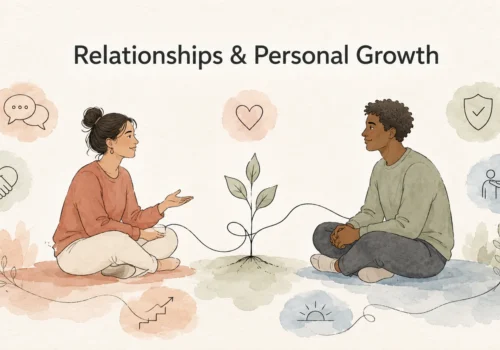

A healthy relationship is not one with constant agreement, perfect communication, or no difficult days. It is a connection in which people can be honest, feel emotionally and physically safe, keep their individuality, and work through problems without coercion or contempt.
Five useful components of a healthy relationship are communication, trust, respect, boundaries, and consent. They overlap and reinforce one another: communication makes needs visible, dependable behavior builds trust, respect protects each person’s dignity, boundaries preserve autonomy, and consent keeps intimacy voluntary.
These five components are a practical framework, not a scientifically validated checklist or guarantee that a relationship will last. Relationship research studies many overlapping factors. In a large project involving 11,196 couples, people’s relationship-specific experiences—including perceived partner commitment, appreciation, sexual satisfaction, perceived partner satisfaction, and conflict—were among the strongest predictors of current relationship quality. However, changes in relationship quality over time were much harder to predict.
What Makes a Relationship Healthy?
A healthy relationship supports the well-being and autonomy of everyone involved. Each person can express needs, make choices, maintain other supportive connections, and say no without fear. Both people take responsibility for their behavior and make room for repair after ordinary mistakes.
Healthy does not mean identical. Partners may have different personalities, cultures, schedules, needs for closeness, sexual interests, or ways of solving problems. Relationship structure is not a reliable shortcut either. A 2025 meta-analysis of 35 studies involving 24,489 people found no overall difference in relationship or sexual satisfaction between monogamous and consensually non-monogamous participants. What matters is whether agreements are honest, mutual, safe, and respected.
| Component | What it looks like | What it is not |
|---|---|---|
| Communication | Clear expression, attentive listening, and respectful disagreement | Mind-reading, shouting, personal attacks, or forced disclosure |
| Trust | Reliability, honesty, accountability, and reasonable privacy | Blind faith, surveillance, or automatic forgiveness |
| Respect | Equal dignity, curiosity, appreciation, and support for autonomy | Agreement on everything or tolerating harmful behavior |
| Boundaries | Clear limits around your body, time, privacy, money, and energy | Rules used to control another adult |
| Consent | Clear, voluntary, specific, ongoing, and reversible agreement | Silence, pressure, past permission, or lack of resistance |
The 5 Essential Components of a Healthy Relationship
1. Open and Respectful Communication
Healthy communication involves speaking clearly and listening to understand. You should be able to discuss affection, household tasks, money, sex, family, work, and disappointment without being mocked, threatened, or punished. You do not have to share every thought immediately, but important information and agreements should not be hidden.
Recent research supports the quality of listening, not just the amount of talking. A 2026 series of studies found that attentive, empathic, nonjudgmental listening supported speakers’ well-being and sense of connection even during disagreement. By contrast, a 2024 observational study of 151 couples linked a demand-withdraw pattern—one partner pressures while the other shuts down—with lower relationship satisfaction and a decline in satisfaction one year later. One study cannot prove that the pattern caused the decline, but it adds to evidence that how couples handle difficult conversations matters.
Try this three-part check-in:
- Describe: “When our plans change without a message…”
- Name the impact: “…I feel worried and unimportant.”
- Make a request: “Could you text me when you know you will be late?”
Listen for the concern underneath the words, reflect what you heard, and ask whether you understood correctly. If either person is overwhelmed, agree on a specific time to return to the conversation. A pause can support regulation; repeatedly disappearing to avoid every concern can become stonewalling. For more tools, explore healthy relationship communication and constructive conflict resolution.
2. Earned Trust and Dependability
Trust is a willingness to rely on someone when their pattern of behavior gives you reasonable grounds to do so. It grows when words and actions match: promises are kept, important truths are shared, private information is protected, and mistakes are acknowledged without excuses.
Trust does not inevitably increase with time. Repeated lying, broken agreements, financial secrecy, humiliation, sexual coercion, or unpredictable behavior can weaken it. Nor does trust require access to every password, message, location, or private conversation. Surveillance may create compliance, but it does not create emotional safety.
After a breach, repair usually needs more than an apology. The person who caused harm should name what happened, listen to its impact, make a concrete change, and behave consistently long enough for trust to be reassessed. The hurt partner can choose the pace of rebuilding and is not obligated to forgive or remain. Our guide to trust issues in relationships explains the difference between protective caution and fear that has generalized from earlier experiences.
3. Mutual Respect and Responsiveness
Respect means treating the other person as a full human being with equal dignity and a separate mind. It includes taking their feelings seriously, asking rather than ordering, sharing influence over joint decisions, and supporting reasonable goals and relationships outside the partnership.
Responsiveness is how respect becomes visible. A responsive partner tries to understand what matters to you, validates the understandable part of your experience, and shows care in a way you can recognize. Validation does not mean agreeing with every interpretation. You might say, “I remember it differently, but I understand why that felt dismissive.” Appreciation also matters: in the large couples study noted earlier, feeling appreciative of a partner was among the strongest relationship-specific predictors of current quality.
Respect is present when both people can:
- disagree without insults, ridicule, or threats;
- make choices about friendships, work, beliefs, clothing, and interests;
- give and receive feedback without attacking character;
- share decision-making and household responsibility fairly; and
- celebrate each other’s growth rather than competing with it.
If worry makes it hard to tell the difference between a present relationship problem and fear carried from past experiences, read about relationship anxiety. Practicing mindful attention in relationships can also help you notice reactions before acting on them.
4. Clear, Flexible Boundaries
A boundary identifies what you are comfortable with and what you will do to care for yourself. It may involve touch, sexual activity, time alone, social media, money, work, family contact, privacy, or how conflict is handled. Boundaries can change as circumstances change, so they need ongoing conversation.
A boundary is not a command that removes another adult’s choice. “I will pause this conversation if name-calling starts, and I will return when we are calm” is a boundary. “You are not allowed to speak to any friends I dislike” is control. Some relationship agreements do ask both people to change behavior, but healthy agreements are discussed freely and can be revisited without intimidation.
Use this simple format: “I am not comfortable with ____. I need ____. If that cannot happen, I will ____.” Then invite the other person’s perspective. The goal is not to feel zero discomfort; it is to make the limit understandable and follow through safely. See our practical guide to setting healthy boundaries for more examples.
5. Freely Given and Ongoing Consent
Consent is a mutual agreement to participate in sexual or intimate activity. It should be clear, voluntary, informed, specific, ongoing, and reversible. A person can change their mind at any time. Agreeing to one activity does not mean agreeing to another, and consent on one occasion does not carry forward automatically.
Consent is not created by silence, freezing, lack of resistance, flirting, clothing, arousal, marriage, or a previous “yes.” It is not freely given when someone is pressured, manipulated, threatened, asleep, under the legal age of consent, or too impaired to make an informed choice. Laws concerning age and capacity vary by location, but ethical practice should never depend on exploiting ambiguity.
People communicate in different ways, including words and behavior. Because nonverbal cues can be misunderstood, ask when there is any uncertainty: “Do you want to keep going?” Notice hesitation, pulling away, silence, or a sudden change in participation and stop to check in. Research published online in 2024 found that perceived partner support for sexual autonomy was associated with greater sexual need fulfillment and relationship satisfaction across three studies. The finding is an association, not proof that autonomy support alone causes satisfaction, but it fits the broader principle that intimacy should protect choice.
How to Strengthen These Components in Daily Life
- Hold a 10-minute weekly check-in. Each person shares one appreciation, one stressor, and one request.
- Make small promises carefully. Reliability is built through repeated follow-through, not dramatic declarations.
- Ask before solving. Try, “Would you like comfort, ideas, or help taking action?”
- Repair specifically. Replace “Sorry you feel that way” with “I interrupted and dismissed your concern. I am sorry. Next time I will let you finish.”
- Protect connection and independence. Plan shared time while respecting friendships, rest, interests, and private reflection.
Common Myths About Healthy Relationships
Myth: Healthy couples never argue
Fact: Disagreement is normal. The important questions are whether conflict remains safe, whether both people can influence the outcome, and whether they repair harm afterward.
Myth: Trust means having no privacy
Fact: Privacy is compatible with closeness. Secrecy hides information that affects shared agreements; privacy preserves reasonable personal space.
Myth: A boundary is a way to make someone behave
Fact: A boundary communicates your limit and your response. It cannot ethically be used to control another person’s identity, support network, or choices.
Myth: Consent is assumed in a committed relationship
Fact: Relationship status does not replace consent. Agreement remains voluntary, activity-specific, and reversible.
Myth: Love is enough to fix harmful behavior
Fact: Care can motivate change, but lasting repair requires accountability, safer behavior, and often outside support. You cannot make another person change through patience alone.
When Relationship Problems Need More Support
Consider a qualified couples therapist when the same conflict repeats, communication has broken down, trust has been damaged, or both people want structured help. Couple therapy can improve relationship outcomes for many couples, but results vary and both people must be willing to participate honestly.
Couples therapy is not automatically appropriate when there is ongoing violence, coercive control, stalking, or fear of retaliation. Joint sessions can create risk if an abusive partner uses information from therapy to punish the other person. Seek confidential guidance from a local domestic-violence or sexual-assault service and make a personalized safety plan. If there is immediate danger, contact local emergency services. Review these warning signs of an unhealthy relationship and our overview of the potential benefits and limits of couples counseling.
Frequently Asked Questions
What are the five components of a healthy relationship?
A useful framework includes communication, trust, respect, boundaries, and consent. These are overlapping relationship skills, not a formal diagnostic test or the only factors that matter.
What is the most important component of a healthy relationship?
No single component works alone. Emotional and physical safety are the minimum. Communication, trust, respect, boundaries, and consent then support one another.
Can a healthy relationship include conflict?
Yes. Healthy partners can disagree. Conflict becomes concerning when it involves fear, threats, humiliation, coercion, violence, repeated personal attacks, or refusal to address harm.
How do you rebuild trust after it is broken?
Start with honest disclosure, responsibility without blame-shifting, space for the impact, an agreed repair plan, and consistent follow-through. Rebuilding takes time, and the harmed person is not required to restore trust or stay.
What is the difference between a boundary and control?
A boundary describes your limit and what you will do. Control uses pressure, punishment, monitoring, or threats to restrict another person’s choices.
Does consent always have to be verbal?
Consent may be communicated through clear words or actions, depending on the people and applicable law. However, silence, freezing, or lack of resistance is not consent. Ask directly whenever there is uncertainty and stop if the other person hesitates, withdraws, or cannot consent.
When should couples seek professional help?
Consider help when recurring problems cause distress, trust or intimacy has been damaged, or your own efforts keep stalling. When there is abuse or fear, seek individual and specialist safety support before joint therapy.
Key Takeaways
- A healthy relationship allows honesty, safety, autonomy, and repair; it does not require perfection.
- Communication, trust, respect, boundaries, and consent are useful, interconnected domains—not a guaranteed formula.
- Judge relationship health by repeated behavior, not promises, labels, or relationship structure alone.
- Consent must remain clear, voluntary, specific, ongoing, and reversible.
- Fear, coercive control, sexual pressure, threats, and violence are safety concerns, not ordinary communication problems.
References
- National Institutes of Health. Build Healthy Relationships: Social Wellness Checklist.
- Joel S, et al. (2020). Machine learning uncovers the most robust self-report predictors of relationship quality across 43 longitudinal couples studies. PNAS.
- Saluk D, Itzchakov G, Weinstein N, Amar M. (2026). Listening across the divide: High-quality listening promotes speakers’ state well-being through basic psychological need satisfaction during disagreements. Journal of Personality and Social Psychology.
- Rosen NO, Dubé JP, Bosisio M, Bergeron S. (2024). Do demand-withdrawal communication patterns during sexual conflict predict couples’ relationship satisfaction, sexual satisfaction, and sexual distress? The Journal of Sex Research.
- Shoikhedbrod A, Harasymchuk C, Impett EA, Muise A. (2026; published online 2024). When a partner supports your sexual autonomy. Personality and Social Psychology Bulletin.
- Anderson JR, et al. (2025). Countering the monogamy-superiority myth: A meta-analysis. The Journal of Sex Research.
- Roth M, et al. (2025). Dyadic coping and communication as predictors of 10-year relationship satisfaction subgroup trajectories. Behavioral Sciences.
- Centers for Disease Control and Prevention. (2024). Preventing Intimate Partner Violence.
- World Health Organization. (2026). Violence against women.
- RAINN. (2026). Consent 101: Respect, Boundaries, and Building Trust.
- O’Malley R, Glenny R, Poppleton S, Timulak L. (2023). A qualitative meta-analysis exploring client-reported outcomes of couple therapy. Psychotherapy.