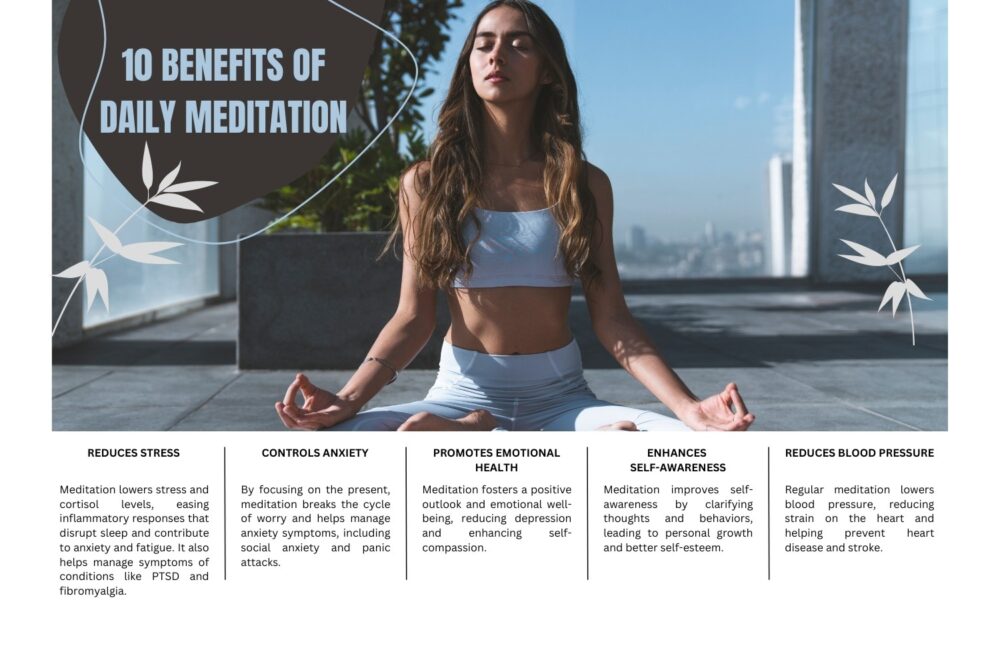

Daily meditation can be a useful wellbeing practice, but it is not a cure-all. The strongest evidence comes from structured mindfulness programmes studied over several weeks—not from proof that every person will experience every benefit after a few minutes a day. This guide explains 10 potential benefits of daily meditation, the numbers behind the research, the limits of that evidence and how to practise safely.
Quick answer: Regular meditation may produce small-to-moderate improvements in perceived stress, anxiety and depressive symptoms. It may also support sleep, pain coping, attention, compassion and blood-pressure management for some people. Results vary by practice, population and comparison treatment, and meditation should complement—not replace—appropriate medical or mental-health care.
Research review updated: 16 August 2026.
Key Takeaways
- The most consistent findings concern stress, anxiety and depressive symptoms, usually after a structured six-to-eight-week programme.
- Effects on sleep, chronic pain, blood pressure, cognition and prosocial behaviour are promising but modest, mixed or dependent on the comparison group.
- Research has not established one ideal “daily dose.” Five minutes can be a practical starting point, not a clinically proven minimum.
- Meditation can sometimes increase anxiety, low mood or unusual experiences. Stop and seek qualified support if symptoms worsen.
What Is Meditation?
Meditation is a family of practices that train attention and awareness. A person might focus on breathing, observe thoughts and sensations without immediately reacting, repeat a phrase, or intentionally cultivate goodwill. Mindfulness is one approach within this wider family; our guide to what mindfulness is and how it works explains the distinction.
“Daily meditation” describes a routine, not a single standardised treatment. Clinical studies often test Mindfulness-Based Stress Reduction (MBSR), Mindfulness-Based Cognitive Therapy (MBCT) or another multicomponent programme. These can include weekly instruction, group support, psychoeducation and substantial home practice. Their results cannot automatically be attributed to a short unguided session.
What the Evidence Shows at a Glance
| Outcome | Research finding | What it does not prove |
|---|---|---|
| Perceived stress | A 2026 meta-analysis reported lower stress after mindfulness-based interventions (standardised mean difference, SMD, −0.53). | That every form of meditation lowers cortisol or prevents stress-related disease. |
| Anxiety disorders | In a 276-person trial, eight-week MBSR met the prespecified noninferiority threshold versus escitalopram for clinician-rated anxiety severity. | That self-guided meditation is equivalent to medication, or that anyone should stop prescribed treatment. |
| Sleep | Across 18 trials and 1,654 participants, mindfulness improved sleep versus nonspecific controls (effect size 0.33), but not versus established sleep treatments. | That meditation cures insomnia or works better than cognitive behavioural therapy for insomnia. |
| Blood pressure | A 2026 review of 21 trials (2,002 adults) estimated reductions of 6.32 mm Hg systolic and 4.09 mm Hg diastolic. | That meditation prevents a heart attack or stroke, or can replace blood-pressure monitoring and treatment. |
| Safety | A review of 83 studies and 6,703 participants estimated meditation-related adverse events in 8.3% of participants. | That meditation is dangerous for most people; risk varied substantially by study type and practice. |
Effect sizes summarise average differences between groups; they do not predict an individual result. Blinding is also difficult in behavioural studies, many outcomes are self-reported, and publication bias can make benefits look larger. A broad review of 47 trials and 3,515 participants found small-to-moderate improvements in anxiety, depression and pain, but no evidence that meditation programmes were better than active treatments such as medication, exercise or other behavioural therapies.
10 Potential Benefits of Daily Meditation
1. It May Reduce Perceived Stress
Meditation gives you a structured pause in which to notice tension, thoughts and impulses without immediately acting on them. A 2026 systematic review and meta-analysis of nonclinical adults found a moderate average reduction in perceived stress after mindfulness-based interventions (SMD −0.53; 95% confidence interval −0.72 to −0.33). That is a self-reported psychological outcome—not proof that meditation reliably changes cortisol or inflammation. For a wider toolkit, see why stress management matters for health.
2. It Can Ease Anxiety Symptoms for Some People
Mindfulness practice may help a person recognise worry as a mental event rather than a command or prediction. In a randomised trial of 276 adults with anxiety disorders, eight weeks of instructor-led MBSR produced a 1.35-point improvement on a clinician-rated severity scale, compared with 1.43 points for escitalopram. The between-group difference was −0.07 (95% CI −0.38 to 0.23), meeting the trial’s noninferiority criterion.
This finding applies to a structured programme with trained instructors and specific eligibility criteria. It does not mean a meditation app is interchangeable with medication. Persistent or disabling anxiety deserves assessment; gentle mindfulness exercises for anxiety can be an adjunct to appropriate care.
3. It May Reduce Depressive Rumination
Meditation can train “decentring”—noticing a thought without treating it as a complete description of reality. A 2025 meta-analysis of 29 randomised trials involving 2,535 people found that MBCT reduced rumination (SMD −0.51; 95% CI −0.64 to −0.39) and depressive symptoms (SMD −0.57; 95% CI −0.79 to −0.34). MBCT combines mindfulness with cognitive therapy, so these results should not be credited to meditation alone.
Meditation is not a substitute for treatment of major depression. If low mood, hopelessness or loss of interest persists—or if you have thoughts of self-harm—contact a qualified professional or local emergency service promptly.
4. It Can Strengthen Emotional Awareness
Repeatedly labelling sensations, thoughts and emotions may create a small gap between feeling and action. In the same 2025 MBCT review, decentring improved (SMD 0.62) and self-compassion improved (SMD 0.59). These are group averages from a therapeutic programme, not guarantees that meditation will always make someone calm or confident. Beginners can build the core skill with this practical guide on how to practise mindfulness.
5. It May Support Better Sleep
Bedtime mindfulness can reduce struggle with racing thoughts, but the comparative evidence is nuanced. A meta-analysis of 18 randomised trials with 1,654 participants found improved sleep versus time-and-attention controls at the end of treatment (effect size 0.33; 95% CI 0.17 to 0.48). It found no meaningful advantage over specific evidence-based sleep treatments (effect size 0.03; 95% CI −0.43 to 0.49).
Chronic insomnia may need cognitive behavioural therapy for insomnia or medical evaluation. Meditation can be one part of a routine alongside a consistent schedule, light exposure and sensible technology use; learn what sleep trackers can and cannot tell you.
6. It May Modestly Lower Blood Pressure
A 2026 meta-analysis of 21 randomised studies with 2,002 adults estimated average reductions of 6.32 mm Hg in systolic and 4.09 mm Hg in diastolic blood pressure after mindfulness-based interventions. Study features, health conditions and methods affected the size of the result, and none of the included trials reported adverse effects. This suggests a possible supportive role, not proof of cardiovascular-disease prevention.
Do not change antihypertensive medication or monitoring based on meditation results. Discuss unusually high or low readings with a clinician.
7. It May Improve How You Relate to Chronic Pain
Mindfulness does not imply that pain is “all in the mind.” It may help some people reduce catastrophising, distress or interference by changing how they respond to painful sensations. A review of 38 randomised trials found low-quality evidence for a small reduction in chronic pain, alongside improvements in depressive symptoms and quality of life. Results varied by condition.
Meditation does not diagnose or cure the source of pain and should not be advertised as “pain relief without medication.” New, severe or unexplained pain requires medical assessment; existing treatment should only be changed with the prescribing clinician.
8. It Can Train Attention, but Cognitive Claims Need Caution
Returning attention to the breath each time the mind wanders is a form of attentional practice. Research reports small, task-specific gains in some groups, but benefits often shrink against active controls. For example, a meta-analysis of 33 trials in children and adolescents found small effects across several outcomes; when only active-control trials were analysed, attention and executive-function advantages were no longer significant.
There is not enough evidence to say daily meditation prevents Alzheimer’s disease, reverses memory loss or “keeps the brain young.” Cognitive changes should be assessed rather than self-treated.
9. Loving-Kindness Practice May Support Compassion
Loving-kindness meditation deliberately rehearses goodwill toward oneself and others. Meta-analyses have found possible improvements in compassion and empathy, especially after loving-kindness or compassion-focused programmes. However, one review found that prosocial effects were limited by study quality and were not reliable for aggression, prejudice or social connectedness. Meditation can support compassionate intentions, but behaviour also depends on context, skills and accountability.
10. It May Support Coping and Quality of Life
Even when symptoms do not disappear, learning to notice an urge or difficult feeling before responding may improve day-to-day coping. Reviews report modest quality-of-life improvements in some pain and clinical populations, although effects are not consistent across every condition. In substance-use treatment, mindfulness may help some people notice cravings and triggers, but evidence is mixed and it should remain one component of comprehensive care. Our review of mindfulness in rehabilitation covers those limits in more detail.
How to Start a Daily Meditation Practice
There is no universally proven number of minutes that unlocks the benefits of daily meditation. Start with a routine you can evaluate honestly:
- Choose five minutes. Treat this as a manageable starting point, not a therapeutic dose.
- Sit or lie down safely. Keep your eyes open if closing them feels uncomfortable.
- Select an anchor. Use breathing, sounds or contact between your body and the chair. If breath focus is activating, choose an external sound or visual object.
- Notice wandering. Gently return to the anchor without grading the session. Wandering is not failure; noticing it is part of the practice.
- Track function, not streaks. After two to four weeks, ask whether sleep, stress, concentration or daily functioning is changing. Do not force longer sessions if you feel worse.
If sitting still feels overwhelming, try slow mindful walking or a brief grounding technique. A qualified, trauma-informed teacher or therapist can adapt practice to your needs.
When Meditation May Not Be the Right First Step
Meditation is often low risk, but “natural” does not mean risk-free. A systematic review of 83 studies involving 6,703 participants estimated that 8.3% experienced an adverse event. Anxiety, depression and cognitive anomalies were the most frequently reported categories, although rates varied widely by study design.
Pause the practice and seek professional guidance if meditation triggers persistent panic, traumatic memories, dissociation, unusual perceptions, severe low mood, loss of sleep or impaired functioning. People with a history of trauma, psychosis, mania, epilepsy or severe anxiety may benefit from shorter, eyes-open, externally anchored practice—or a different coping strategy—under qualified guidance. Urgent safety concerns require local emergency or crisis support.
Advertising and partnership disclosure: This article contains no paid recommendation. Beyond Psychub may consider clearly labelled collaborations with evidence-aligned meditation educators, privacy-conscious wellbeing apps, publishers or nonmedical meditation accessories. Sponsors cannot determine clinical claims, and any paid link or placement must be identified as sponsored or an advertisement. Advertising is not medical endorsement.
Frequently Asked Questions
Is daily meditation scientifically proven to work?
Research supports potential benefits, especially for stress, anxiety and depressive symptoms, but effects are averages and vary across people. Most strong studies test structured programmes over several weeks, not meditation frequency alone.
How long should a beginner meditate each day?
Five minutes is a practical starting point. Increase gradually if the practice feels useful and tolerable. Research does not establish one ideal daily duration for everyone.
How quickly do meditation benefits appear?
A single session may feel calming, neutral or uncomfortable. Clinical studies commonly measure outcomes after six to eight weeks, so claims of guaranteed instant or permanent change are not evidence based.
Can meditation replace therapy or medication?
No. Meditation can be a complementary skill, but it does not replace diagnosis, psychotherapy, prescribed medication or urgent care. Discuss treatment changes with the relevant clinician.
Can meditation make anxiety worse?
Yes, it can for some people. Shorten or stop the session, open your eyes, orient to the room and seek qualified support if anxiety persists or functioning declines.
The Bottom Line
The benefits of daily meditation are plausible and supported most clearly for stress, anxiety and depressive symptoms, but the size and reliability of effects differ. Sleep, pain, blood pressure, attention and compassion may improve for some people, yet none of these outcomes is guaranteed. A short, tolerable practice can be worth trying as part of a broader wellbeing or treatment plan. Measure whether it helps your real life, respect warning signs and use professional care when symptoms are persistent, severe or unsafe.
Research and Clinical Sources
- National Center for Complementary and Integrative Health: Meditation and Mindfulness—Effectiveness and Safety
- Meditation Programs for Psychological Stress and Well-Being: Systematic Review and Meta-Analysis
- MBSR vs Escitalopram for Adults With Anxiety Disorders: Randomised Clinical Trial
- Mindfulness-Based Interventions and Perceived Stress in Nonclinical Adults: Systematic Review and Meta-Analysis
- MBCT for Rumination and Related Psychological Outcomes: Systematic Review and Meta-Analysis
- Mindfulness Meditation and Sleep Quality: Meta-Analysis of Randomised Trials
- Mindfulness-Based Interventions and Blood Pressure: Meta-Analysis of Randomised Trials
- Mindfulness Meditation for Chronic Pain: Systematic Review and Meta-Analysis
- The Limited Prosocial Effects of Meditation: Systematic Review and Meta-Analysis
- Adverse Events in Meditation Practices and Meditation-Based Therapies: Systematic Review
Medical disclaimer: This article is for general education and is not medical advice, diagnosis or treatment. Meditation may not be suitable for everyone and can occasionally worsen symptoms. Do not stop or change medication, psychotherapy or other care without consulting a qualified professional. Seek urgent local help for a medical emergency, suicidal thoughts, loss of contact with reality or immediate danger.