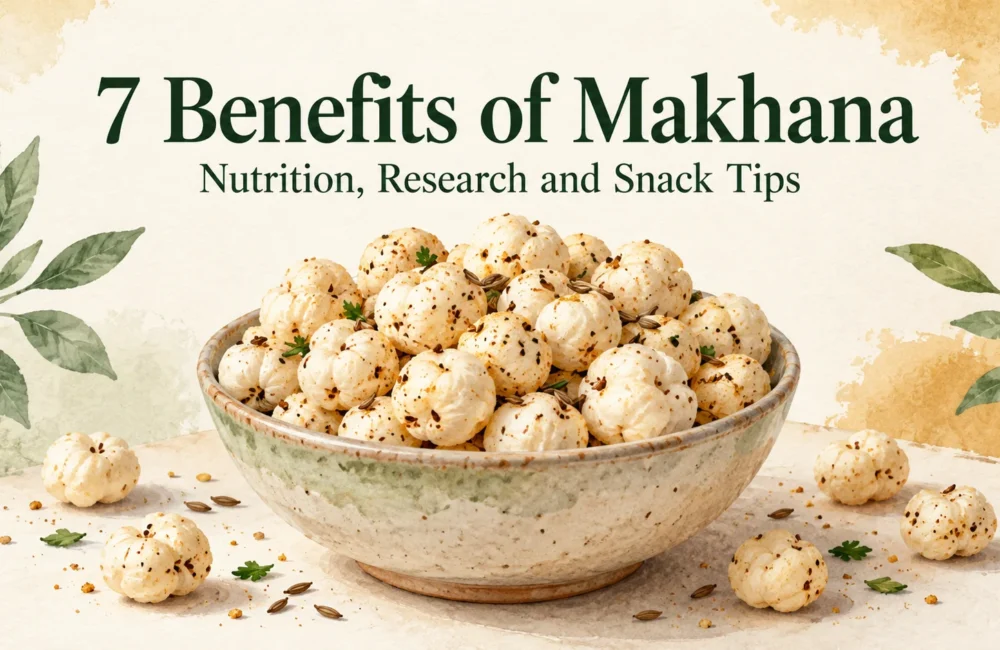

Makhana can be a useful snack because it provides starchy energy, some plant protein and a versatile alternative to heavily coated snack foods. Plain makhana is also naturally gluten-free and can be prepared with little added fat or sugar. Its benefits depend on the product, portion and the rest of your diet—not on a “superfood” label.
You may know it as fox nuts, phool makhana or popped water-lily seeds. This guide separates seven nutritional and practical advantages from health claims that go beyond the evidence. It is about enjoying food and understanding nutrition, not using makhana to treat a condition.
Evidence checked: 3 October 2026.
On This Page
- What Is Makhana?
- 7 Nutritional and Practical Benefits of Makhana
- Makhana Nutrition: Read the Portion, Not Just the Claim
- What Does the Latest Research Actually Show?
- How to Eat Makhana as Part of a Varied Diet
- How to Choose and Store Makhana
- Precautions and Common Misunderstandings
- Frequently Asked Questions
- Key Takeaways
- References
What Is Makhana?
Makhana comes from Euryale ferox, an aquatic plant in the water-lily family. The familiar white, airy snack is made by processing and popping its seed kernels. Although shops sometimes call it “lotus seeds,” it is not the same plant as the true lotus, Nelumbo nucifera. The European food specification identifies the popped product as Euryale ferox.
For shopping and cooking, distinguish plain popped makhana from raw hard seeds, flour and ready-seasoned snacks. They differ in preparation and may differ substantially in their nutritional profile. This article mainly concerns the popped snack sold in Indian shops.
Educational note: This article provides general food and nutrition information, not diagnosis, treatment or a personalised diet plan. Makhana is not a substitute for medicines or professional advice. If you have a food allergy, swallowing difficulty or a prescribed diet, ask a qualified professional how a particular product fits your needs.
7 Nutritional and Practical Benefits of Makhana
1. It provides carbohydrate energy
Makhana is primarily a starchy food. That makes it an energy-containing snack, not a carbohydrate-free substitute. A July 2026 review describes starch as its dominant component and notes that variety, origin and processing affect composition.
If you want something crunchy between meals, a serving can be one option. It need not replace a balanced meal, and it should not be described as providing guaranteed “all-day energy.”
2. It contributes some plant protein
Makhana contributes protein, but serving size matters more than a large per-100-gram headline. For example, ICAR-CIPHET reports 10.54 g protein per 100 g on a dry basis for its specific fat-free flavoured product. That corresponds to roughly 3.2 g per 30 g of dry product—not 10 g per small bowl.
Treat it as a contribution, not your main protein source. Depending on your preferences, pair your snack with curd, milk, soy yoghurt or roasted chickpeas.
3. Plain versions can keep added fat modest
You can warm plain popped makhana in a dry pan, or use a little oil for seasoning. This gives you control over added fat. Oil-coated commercial varieties can have a very different profile, even when the front of the packet says “roasted.”
Lower fat is not automatically better for every person or every meal. Nuts and seeds containing unsaturated fats can also fit a balanced diet. Compare the actual snack and portion rather than assuming makhana wins every comparison.
4. It offers a naturally gluten-free base
Plain makhana is naturally gluten-free. This makes it another ingredient to consider when varying gluten-free snacks, alongside other suitable foods.
Flavourings, coatings and shared manufacturing equipment still matter. People who must avoid gluten should choose a product with appropriate gluten-free labelling rather than relying on the name alone. Gluten-free does not mean universally more nutritious.
5. It can be enjoyed without a sugary coating
Makhana does not need caramel, honey or jaggery to be enjoyable. Cumin, black pepper, turmeric or other seasonings can provide a savoury option if that is what you prefer.
The practical advantage is choosing a preparation with no added sweetener—not a special property that neutralises sugar elsewhere in your diet. Sweet versions can still be enjoyed, but their ingredients and portion deserve the same attention as other sweet snacks.
6. It adds variety to familiar meals and snacks
Its mild flavour makes makhana easy to use in different ways: crisp as a snack, softened in a curry, or cooked into kheer. These preparations are different foods nutritionally; milk, sugar, salt and cooking fat all change the final dish.
Variety is useful because no single food supplies everything you need. Keep fruit, vegetables, pulses, whole grains and suitable protein foods in the wider picture. Makhana is an option, not a daily requirement.
7. It is convenient to portion and carry
A container of cooled roasted makhana can be practical for work or travel. Preparing a snack you actually enjoy may make an eating routine easier to follow. This is a convenience benefit, not evidence that makhana directly changes metabolism.
Pack it alongside something that rounds out the snack, such as fruit and a protein-containing food. The right combination depends on your appetite, access and preferences; there is no need to force a snack when you are not hungry.
For the bigger picture, our evidence-based health and wellness guide explains how everyday food choices fit alongside movement, sleep and other habits.
Makhana Nutrition: Read the Portion, Not Just the Claim
There is no single nutrition panel that accurately describes every makhana product. Avoid copying numbers from raw seeds onto a packet of popped, flavoured kernels. Moisture levels, processing and added ingredients affect the comparison.
| Label item | What to check | Why it matters |
|---|---|---|
| Serving size | Grams you actually eat | A bowl or handful is not a standard weight. |
| Energy | Calories per serving, not only per 100 g | An airy texture does not mean calorie-free. |
| Protein and fibre | Grams per serving | “Contains” is not the same as a substantial contribution. |
| Fat | Amount and ingredients such as oil or ghee | Plain and coated versions can differ considerably. |
| Sodium and added sugars | Compare like-sized portions | Seasoning and sweet coatings change the snack. |
For a simple calculation, multiply a per-100-g value by the portion weight and divide by 100. If your packet lists 360 kcal per 100 g, a 25 g portion provides 90 kcal before anything you add. This is an arithmetic example, not a universal makhana value or a prescribed serving.
The ICAR-CIPHET product analysis also illustrates why fibre claims need care: it lists 3.26 g per 100 g on a dry basis, or about 1 g per 30 g of dry product. These figures describe that formulation, not every brand. Do not rely on makhana alone to supply your fibre.
What Does the Latest Research Actually Show?
Much of the makhana literature examines food composition, starch structure or laboratory activity. Those studies can tell us what is in a sample or how processing changes it. They cannot, on their own, demonstrate a health benefit from eating an ordinary snack.
- 2026 review: A review of makhana starch and protein highlights variation with growing conditions and processing. It is a useful food-science overview, not a new trial proving benefits in consumers.
- 2025 food-processing research: A study of 72-hour germination found changes in makhana flour, including reduced measured phytate and tannins. Germinated flour is not equivalent to ordinary popped makhana; the study did not establish health outcomes in people.
- Small human study: A 2022 study reported a glycaemic index of about 37 for its roasted sample in ten healthy adults aged 18–30. That result does not establish the response to every brand, recipe or serving, and it was not a treatment trial.
- Laboratory findings: The same roasting study measured phenolic compounds and antioxidant activity. A laboratory antioxidant result is not proof that eating makhana prevents ageing, protects an organ or treats disease.
Processing can also change starch digestibility. Research on enzyme-treated makhana flour investigated deliberately modified resistant starch, not the usual snack. This is one reason to avoid blanket claims that all makhana is “slow-digesting.”
The sensible conclusion is modest: makhana is a usable food ingredient with nutritional value. The sources above do not establish broad promises about weight loss, fertility, sleep, kidney “detox” or reversing ageing. Newer publication dates do not remove the need to check what was actually tested.
Advertising and partnership disclosure: Advertisements may appear on this website. Their presence does not mean the products are endorsed by this article. The guidance below does not recommend a particular brand.
How to Eat Makhana as Part of a Varied Diet
Start with ready-popped makhana and follow any preparation instructions on the packet. For a simple savoury version, warm it in a dry pan over gentle heat, stirring until crisp. Add a little oil if wanted, then spices and salt to taste. Avoid burning it.
- Serve a portion with plain curd and fruit for a more varied snack.
- Add it to a vegetable curry for a different texture, remembering it absorbs the sauce.
- Make kheer if you enjoy it, while recognising that the milk, sugar and portion determine much of the finished dish’s nutrition.
- Use a small container for an outing rather than assuming an entire large packet equals one serving.
There is no research-established daily makhana dose for general wellbeing. A weighed 20–30 g amount can help you understand the label, but it is an example—not a requirement, a maximum or the right amount for everyone. Adjust to hunger, the rest of the meal and your individual needs.
If planning snacks is the difficult part, our habit-design worksheet can help you choose a convenient cue and preparation step. It is a routine-building tool, not a nutrition prescription.
How to Choose and Store Makhana
- Read the ingredients before the health claims. Compare plain, salted and sweetened versions on equal weights.
- Check the best-before date and packaging instructions. Keep dry makhana sealed away from moisture.
- Let freshly roasted makhana cool before sealing it so trapped steam does not make it soft.
- Discard products that smell off, show mould or have damaged packaging; do not try to make spoiled food safe by reheating.
- Choose according to taste, budget and dietary needs. A premium price or “superfood” label does not establish superior health effects.
The WHO healthy-diet guidance emphasises dietary variety and moderation in salt and free sugars. That principle is more useful than searching for one perfect snack. Our guide to healthy habits before 60 places food choices within a longer-term routine.
Precautions and Common Misunderstandings
Makhana is not automatically suitable for every person. Check coatings for ingredients such as milk or nuts, and avoid anything to which you are allergic. Whole crunchy pieces may be unsuitable for young children or people with chewing or swallowing difficulties; use age- and ability-appropriate foods and seek individual guidance when needed.
If a prescribed diet limits carbohydrate, sodium or particular minerals, use your own product label and professional plan. Do not change medicines or treatment based on an online food-benefits list. Eating more than is comfortable can also cause digestive discomfort; persistent symptoms deserve appropriate advice.
Finally, healthy eating does not require buying makhana. If it is expensive or unavailable, other familiar foods can fill the snack role. Enjoyment, adequate nourishment and an affordable varied diet matter more than following a trend.
Frequently Asked Questions
Is makhana the same as lotus seeds?
Not botanically. Makhana is Euryale ferox, a water-lily seed; true lotus seeds come from Nelumbo nucifera. Retail names can be confusing, so check the ingredient name.
Is makhana high in protein?
It contributes protein, but a small serving generally supplies only a modest amount. Read the grams per serving and include other protein foods rather than treating makhana as a protein supplement.
Can I eat makhana every day?
It can fit a varied diet if you enjoy and tolerate it, but there is no requirement to eat it daily. Portion, preparation and the rest of your diet matter more than frequency alone.
Does makhana help with weight loss?
It does not burn fat. Changing a snack may change energy intake, but the effect depends on what it replaces, portion size and the overall eating pattern. This article does not recommend makhana as a weight-loss treatment.
Is roasted makhana better than fried makhana?
Dry-roasted or lightly seasoned versions can contain less added fat, but “roasted” products may still be oil-coated. Compare the label instead of relying on the cooking term.
What is the best time to eat makhana?
There is no established special time that unlocks its benefits. Eat it when it fits your appetite and routine; there is no need to eat it on an empty stomach or before bed.
Key Takeaways
- Makhana is a starchy popped seed, not a treatment or a complete food.
- Its most defensible advantages are nutritional contributions, flexible preparation and convenience.
- Check actual serving sizes and added oil, salt and sugar.
- Research on extracts, modified flour or laboratory antioxidants cannot be directly applied to everyday snacking.
- Keep it optional within a varied, enjoyable and affordable diet.
References
- ICAR-CIPHET. Fat Free Flavored Makhana: product composition and processing information.
- European Commission. Regulation (EU) 2023/652: roasted and popped Euryale ferox seed kernels.
- Kamaleeswari K, et al. (2026). Exploring starch and protein as core nutritional components of Euryale ferox (fox nut).
- Islam Z, et al. (2025). Effect of germination on physicochemical, functional and antinutritional characteristics of makhana seed flour.
- Liaquat M, et al. (2022). Roasted fox nuts: composition, antioxidant assays and glycaemic-index study.
- Biswas P, et al. (2020). Enzyme mediated resistant starch production from Indian Fox Nut and studies on digestibility and functional properties.
- World Health Organization. Healthy diet.