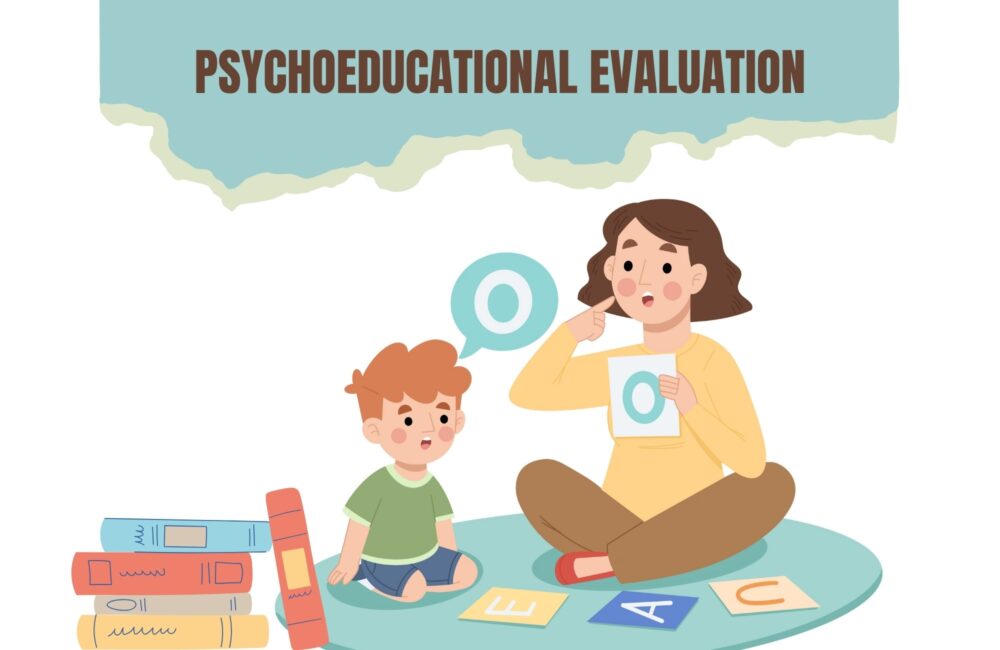

A psychoeducational evaluation helps explain how a child learns, where school difficulties are occurring, what strengths can support learning, and what additional help may be appropriate. It usually combines several sources of information rather than relying on one score or one test.
Quick answer: A psychoeducational evaluation may include academic achievement testing, cognitive or processing measures when relevant, interviews, school records, teacher and parent reports, behavioral or emotional rating scales, classroom data, and information about the child’s response to instruction. The goal is not simply to attach a label. A good evaluation asks which difficulties are present, what may be contributing to them, how they affect everyday learning, and what supports are likely to help.
Current evidence also supports caution. No single test can reliably explain every learning or attention problem, and assessment practices for conditions such as dyslexia continue to evolve. The most useful evaluations integrate test results with developmental history, instruction, language and cultural context, observations, and real-world functioning.
Research review updated: 28 August 2026.
On This Page
- What a psychoeducational evaluation is
- When a child may benefit from evaluation
- What the evaluation may measure
- What recent research says
- What happens during the evaluation process
- How results can guide school support
- How to choose a qualified evaluator
- Common myths
- Frequently asked questions
- Key takeaways
- References
What Is a Psychoeducational Evaluation?
A psychoeducational evaluation is a structured assessment of learning and related areas of functioning. Depending on the referral question, it may examine reading, writing, mathematics, reasoning, memory, attention, executive functioning, language, behavior, emotional functioning, or other areas that affect school participation.
The exact process varies by country, school system, evaluator, and the child’s needs. In U.S. public schools, the Individuals with Disabilities Education Act (IDEA) requires evaluations to use a variety of tools and strategies and says that no single measure may be the sole basis for deciding disability eligibility or an educational program. Assessments must also be sufficiently comprehensive to identify relevant educational needs.
This distinction matters because a low test score does not automatically equal a disorder, and an average score does not necessarily mean a child is functioning well in every classroom demand. Evaluation is a process of integrating evidence.
When Might a Child Benefit From a Psychoeducational Evaluation?
Not every school struggle requires a full evaluation. Temporary difficulty can follow illness, a change of school, inconsistent instruction, stress, sleep problems, family disruption, missed classes, or learning in a new language. An evaluation becomes more useful when concerns are persistent, significant, or difficult to explain.
- Reading, spelling, writing, or mathematics remain unusually difficult despite appropriate teaching and practice.
- A child understands material verbally but has persistent difficulty showing that knowledge through written work, reading, tests, or independent assignments.
- Teachers and parents notice ongoing problems with attention, organization, memory, task completion, or classroom behavior across settings.
- Academic performance is much more uneven than expected from the child’s overall learning opportunities and observed strengths.
- A child has repeated school frustration, avoidance, or loss of confidence connected with learning difficulties.
- There are questions about giftedness, twice-exceptionality, or an unusually uneven pattern of strengths and needs.
- Existing classroom supports have not been enough and the school or family needs clearer information to plan next steps.
Behavior alone should not be assumed to prove a disorder. Our guide to emotional and behavioral disorders in children explains why context, duration, impairment, developmental expectations, and alternative explanations all matter.
What Does a Psychoeducational Evaluation Measure?
The evaluation should be designed around the referral question, not around a fixed battery given to every child. Common components include:
- Academic achievement: reading accuracy and fluency, reading comprehension, spelling, written expression, mathematics calculation, and mathematical reasoning as appropriate.
- Cognitive abilities: selected measures of reasoning, working memory, processing speed, or other cognitive functions when they are relevant to the question being asked.
- Attention and executive functioning: rating scales, interviews, observations, and sometimes performance-based tasks related to attention, inhibition, planning, or organization.
- Language and communication: receptive and expressive language, phonological skills, or referral for speech-language assessment when language may be contributing to learning difficulty.
- Social, emotional, and behavioral functioning: reports from the child, parents, and teachers, interpreted in context rather than treated as stand-alone diagnoses.
- Developmental and educational history: milestones, school attendance, prior interventions, classroom performance, medical or sensory factors, family history, and learning opportunities.
- Response to instruction: progress-monitoring and intervention data that show what has already been tried and how the child responded.
For children being evaluated for attention problems, current pediatric guidance emphasizes information from more than one setting and screening for other developmental, emotional, behavioral, and physical conditions. A 2024 systematic review of ADHD diagnostic tools similarly concluded that no single test or informant is a gold standard; clinical judgment must integrate standardized measures with information from parents, teachers, school staff, and the child when appropriate.
Educational note: This article provides general educational information and cannot determine whether a particular child has ADHD, dyslexia, autism, a learning disorder, an intellectual disability, anxiety, or another condition. School eligibility rules and professional scopes of practice vary by jurisdiction. A sudden loss of previously acquired skills, seizures, significant vision or hearing changes, severe emotional distress, self-harm concerns, or other new medical symptoms require appropriate healthcare assessment rather than relying only on psychoeducational testing.
What Does Recent Research Say?
The strongest current message is not that one particular test battery is “best.” It is that assessment should be comprehensive, hypothesis-driven, connected to instruction, and interpreted cautiously.
| Evidence | What it adds | Important limitation |
|---|---|---|
| 2025 review of 160 learning-disability assessment studies | Emphasized early identification, objective assessment, interdisciplinary collaboration, and the growing role of technology-assisted screening. | Emerging tools such as AI, VR, and digital screening are not substitutes for validated comprehensive assessment. |
| 2024 review of SLD and intellectual-disability assessment | Highlighted the need to distinguish disorders using valid classification and multiple data sources rather than simplistic score patterns. | There is continuing debate about the role of cognitive-profile and discrepancy approaches in SLD identification. |
| 2024 AAP systematic review of ADHD diagnostic tools | Found that diagnostic tools are less accurate when distinguishing ADHD from other clinical problems and supported multi-informant, multi-setting assessment. | Rating scales and neuropsychological tests alone can produce false positives and false negatives. |
| 2024 Tennessee RTI study | Statewide response-to-intervention adoption was associated with fewer first-time SLD identifications by third grade. | The study could not determine whether the decline reflected better learning outcomes or delayed/missed identification, so RTI data should not be interpreted as a reason to postpone needed evaluation. |
| 2025 dyslexia consensus and subsequent debate | Experts supported assessment that weighs multiple hypotheses, while later commentary argued for stronger emphasis on direct reading performance rather than cognitive-discrepancy methods. | Professional consensus is still developing; parents should be cautious of claims that one cognitive pattern definitively “proves” dyslexia. |
A practical takeaway is that test scores should answer educational questions, not become an end in themselves. Direct measures of academic skills, instruction history, classroom performance, progress data, and functional impact are central. Cognitive testing may add useful information in some cases, but it should not overshadow what the child can actually do in reading, writing, mathematics, language, and everyday school tasks.
What Happens During a Psychoeducational Evaluation?
- Referral question: The family, school, or clinician clarifies the main concern. “Why is reading so difficult?” is more useful than simply “test for dyslexia.”
- Consent and history: The evaluator reviews developmental, educational, language, medical, and family information relevant to learning.
- Existing data review: Report cards, school assessments, attendance, prior interventions, work samples, and teacher observations can reveal patterns that one testing session cannot.
- Direct assessment: Standardized measures are selected based on the referral question. Testing may occur across one or several sessions.
- Multi-informant information: Parent, teacher, and sometimes child rating scales or interviews help show whether concerns occur across environments.
- Integration: The evaluator examines how the pieces fit together, considers alternative explanations, and identifies both strengths and needs.
- Feedback and report: Families should receive an understandable explanation of findings, limitations, recommendations, and next steps—not just a list of scores.
For some children, concerns may point beyond a psychoeducational evaluation. For example, autism assessment requires a broader developmental evaluation by appropriately qualified professionals. See our evidence-based guide to autism signs, diagnosis, and support for that distinction.
How Can Evaluation Results Guide School Support?
A psychoeducational report can help translate a vague concern such as “school is hard” into specific, teachable needs. Recommendations might address explicit reading instruction, math intervention, writing support, organizational systems, assistive technology, classroom seating, reduced distraction, test conditions, or other accommodations depending on the evidence.
In the United States, evaluation data can contribute to decisions about eligibility and services under IDEA and Section 504, but testing does not automatically create an Individualized Education Program (IEP) or 504 Plan. Eligibility is determined through the applicable legal and school-team process. Other countries use different systems.
IDEA also requires school evaluations to consider multiple sources of data, use tools that are valid for their intended purpose, avoid racial or cultural discrimination, and when feasible assess children in their native language or mode of communication. These safeguards matter for multilingual children and for students whose opportunities to learn have differed.
Why Early Identification Can Help—But Labels Are Not the Goal
Earlier identification can make it possible to provide targeted instruction before years of repeated failure accumulate. A 2025 review of learning-disability assessment emphasized the value of early and objective identification. However, evaluation itself is not a treatment and does not guarantee better outcomes. The benefit comes when accurate findings lead to appropriate teaching, accommodations, follow-up, and progress monitoring.
Children with learning and language disorders also show higher average rates of internalizing and externalizing difficulties than comparison groups in meta-analytic research. That does not mean learning problems inevitably cause anxiety or behavior problems, but it reinforces the importance of looking at the whole child rather than treating grades as the only outcome. For broader context, see how mental-health education can improve awareness and support.
How to Choose a Qualified Evaluator
Qualifications differ by jurisdiction, but parents can ask practical questions before booking an assessment:
- What professional license, certification, or school-system qualification do you hold?
- How often do you evaluate children with this type of learning concern?
- How will you review school records, prior interventions, teacher input, and developmental history?
- How do you adapt assessment for multilingual, culturally diverse, sensory, motor, or communication needs?
- Will the report explain strengths, limitations, educational impact, and practical recommendations?
- Will you provide a feedback meeting where parents can ask questions?
- Does the school or local authority accept outside evaluations, and what additional process is required for eligibility decisions?
Parents should be cautious if a service guarantees a diagnosis before evaluation, relies on one online test, promises that a single IQ or processing score will explain all school difficulty, or recommends an expensive treatment package before interpreting the full evidence.
Advertising and partnership disclosure: This article contains no paid recommendation. Suitable future collaborations could include licensed psychology or school-psychology practices, evidence-based educational assessment services, learning-support platforms, assistive-technology providers, parent education resources, and credential-verified tutoring services. Sponsors may not determine diagnostic claims, evidence summaries, or recommendations. Any paid placement or commercial link must be clearly labelled as sponsored or advertising. Services that guarantee diagnoses, promote unsupported “brain training” cures, or sell a treatment before an appropriate assessment are not suitable partners.
Common Myths About Psychoeducational Evaluations
Myth: One test can diagnose a learning disability
A comprehensive decision should integrate multiple measures and sources of information. U.S. IDEA regulations explicitly prohibit using a single measure as the sole criterion for disability determination or educational programming.
Myth: A psychoeducational test automatically diagnoses ADHD
No. ADHD diagnosis requires clinical assessment of symptoms, impairment, developmental history, alternative explanations, and functioning across more than one setting. Test results may contribute useful information, but they are not a stand-alone ADHD diagnosis.
Myth: A high IQ means a child cannot have a learning disorder
Children can have strong reasoning abilities and still have persistent, functionally important difficulties in reading, writing, or mathematics. Modern SLD identification does not depend solely on a severe IQ-achievement discrepancy.
Myth: Schools should wait until a child fails badly
Persistent difficulty should be addressed with appropriate instruction and progress monitoring, and a suspected disability may warrant formal evaluation. Support and assessment should not be framed as rewards that a child earns only after prolonged failure.
What Parents Can Do Before and After the Evaluation
- Collect examples of schoolwork that show the concern over time.
- Write down when the difficulty began and what strategies have already been tried.
- Ask teachers for concrete examples rather than general descriptions such as “not trying.”
- Share relevant developmental, language, health, hearing, vision, sleep, and attendance information.
- Ask the evaluator to explain scores in plain language and connect them with classroom functioning.
- Request specific recommendations that can be monitored, not vague advice such as “work harder.”
- Review progress after supports are implemented and revisit the plan if the child is not improving.
Assessment also has limits. A child may need instructional support, medical care, speech-language evaluation, occupational therapy, mental-health care, or another service in addition to—or instead of—a psychoeducational evaluation. Non-clinical coaching can support everyday goals and routines but should not be used as a substitute for diagnostic assessment; our parent guide to life coaching for kids explains that boundary.
Frequently Asked Questions
What age can a child have a psychoeducational evaluation?
There is no single universal age. The timing depends on the concern and the tools available for the child’s developmental level. Formal academic testing becomes more informative as children receive instruction, but significant developmental or learning concerns can be evaluated earlier through age-appropriate methods.
How long does a psychoeducational evaluation take?
It varies widely. Direct testing may take several hours across one or more sessions, while a comprehensive evaluation also includes record review, interviews, questionnaires, scoring, interpretation, report writing, and feedback. School systems may have legal timelines that differ by jurisdiction.
Can a psychoeducational evaluation diagnose dyslexia?
An appropriately qualified evaluator may identify a specific learning disorder or dyslexia when the evidence and local professional rules support that conclusion. The assessment should include direct measures of reading and related academic skills and should not rely on one IQ score or cognitive pattern alone.
Can psychoeducational testing diagnose ADHD?
Testing can contribute information about attention, executive functioning, academic impact, and possible co-occurring learning difficulties, but ADHD is a clinical diagnosis. Current guidance emphasizes symptoms and impairment across settings, multiple informants, developmental history, and ruling out alternative explanations.
Does an evaluation automatically qualify a child for an IEP or 504 Plan?
No. In the United States, evaluation findings may contribute to IDEA or Section 504 eligibility decisions, but qualification is determined through the applicable school and legal process. Rules in other countries differ.
What if the school and private evaluator disagree?
Ask each team to explain which data support its conclusion, which criteria were applied, and how the child’s functional educational needs are being addressed. Parents can also ask about local procedures for independent evaluations, review, mediation, or appeal where applicable.
Should a multilingual child be tested in English only?
Not automatically. Language exposure and proficiency can strongly affect test performance. In U.S. public-school evaluations, IDEA requires assessments to be administered in the child’s native language or other mode of communication when feasible and in a form most likely to produce accurate information.
The Bottom Line
A psychoeducational evaluation can be valuable when a child has persistent learning, attention, or school-functioning concerns that are not adequately explained by ordinary variation or temporary stress. Its value comes from integrating multiple sources of evidence and turning that information into practical educational decisions. The goal is not to define a child by a score. It is to understand the child’s learning needs accurately enough to provide better instruction, appropriate support, and a clearer path forward.
Key Takeaways
- A psychoeducational evaluation is a multi-source process, not one test.
- Direct academic measures, history, classroom data, observations, and response to instruction are central to understanding learning problems.
- No single score reliably diagnoses ADHD, dyslexia, or every learning disability.
- Evaluation results can inform school supports, but they do not automatically create an IEP, 504 Plan, or equivalent service.
- Cultural background, language, disability, sensory needs, and educational opportunity must be considered when interpreting results.
- Early identification can support earlier intervention, but the real benefit depends on what happens after the evaluation.
References
- U.S. Department of Education. IDEA §300.304: Evaluation procedures.
- U.S. Department of Education. IDEA §300.305: Additional requirements for evaluations and reevaluations.
- Tv M, Manivannan M, Albert S. Early identification and enhanced assessment of learning disabilities: A review. Applied Neuropsychology: Child. 2025.
- Fletcher JM, Miciak J. Assessment of Specific Learning Disabilities and Intellectual Disabilities. Assessment. 2024;31(1):53-74.
- American Academy of Pediatrics. Tools for the Diagnosis of ADHD in Children and Adolescents: A Systematic Review. Pediatrics. 2024.
- American Academy of Pediatrics. Clinical Practice Guideline for the Diagnosis, Evaluation, and Treatment of ADHD in Children and Adolescents.
- Gilmour AF, Harper J, Lloyd B, Van Camp A. Response to Intervention and Specific Learning Disability Identification: Evidence From Tennessee. Journal of Learning Disabilities. 2024;57(3):168-180.
- The Use of Cognitive Tests in the Assessment of Dyslexia. Journal of Intelligence. 2023.
- Towards a Consensus for Dyslexia Practice: Findings of a Delphi Study on Assessment and Identification. Dyslexia. 2025.
- A narrative review of school-based screening tools for dyslexia among students. 2025.
- Consensus Without Clarity for Dyslexia Identification: A Commentary on Holden et al. 2025.
- Research Review: Language and specific learning disorders in children and their co-occurrence with internalizing and externalizing problems: systematic review and meta-analysis.