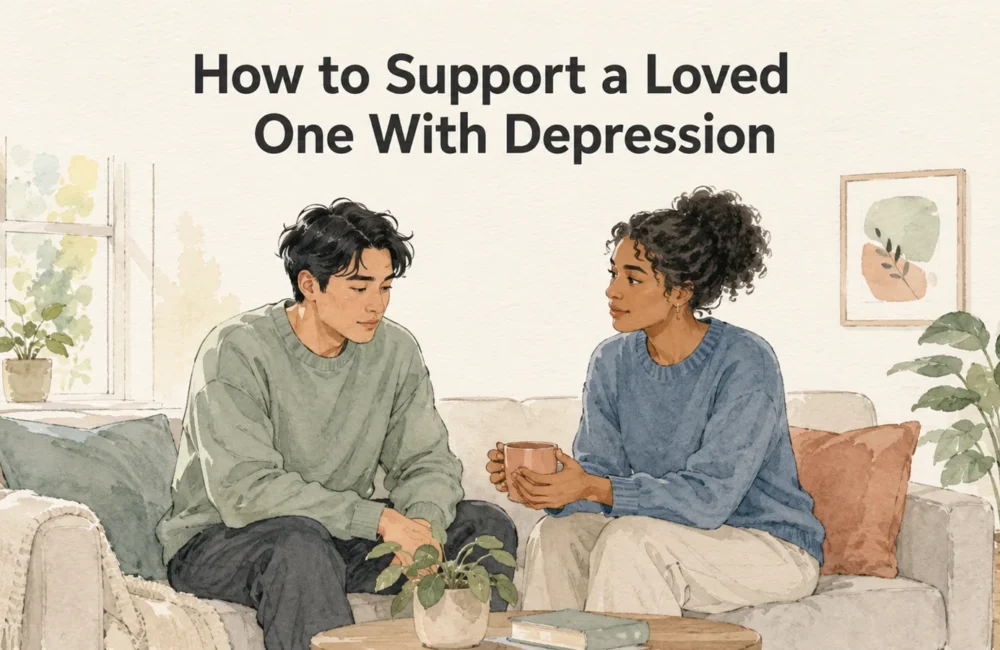

Watching someone you care about struggle with depression can leave you unsure what to say, how much to help, and when to step in. You may worry about saying the wrong thing, pushing too hard, or missing a warning sign. The most useful role is usually not to become their therapist. It is to stay connected, listen without judgment, reduce practical barriers to care, take suicide risk seriously, and protect your own health while you support them.
Depression is different from a difficult day or a short period of sadness. The World Health Organization estimates that about 5.7% of adults worldwide experience depression. Symptoms can affect mood, energy, sleep, concentration, appetite, relationships, work, and a person’s sense of hope. Effective psychological and medical treatments are available.
Quick answer: To support a loved one with depression, notice persistent changes, start a calm conversation, listen more than you advise, ask what kind of help would be useful, offer specific practical support, encourage professional care, stay in contact, and learn how to respond if suicide risk appears. You can be an important part of someone’s support system, but you are not responsible for curing their depression or managing it alone.
Research review updated: September 2, 2026.
Understand What Depression Can Look Like
Depression can involve a persistently low, sad, irritable, or empty mood, or a marked loss of interest or pleasure. Symptoms generally last most of the day, nearly every day, for at least two weeks when a depressive episode is diagnosed. Not everyone looks visibly sad.
Common changes can include:
- Loss of interest in hobbies, work, sex, or social activities
- Fatigue, slowed movement, or feeling unable to begin basic tasks
- Sleeping too much, too little, or at unusual times
- Changes in appetite or weight
- Trouble concentrating, remembering, or making decisions
- Withdrawal from friends and family
- Irritability, anger, agitation, or restlessness
- Feelings of guilt, worthlessness, or hopelessness
- More alcohol or drug use
- Thoughts about death, self-harm, or suicide
These signs are not enough for a family member or friend to diagnose depression. Medical conditions, medications, substance use, grief, bipolar disorder, and other mental-health conditions can produce overlapping symptoms. A professional assessment matters, especially when symptoms are persistent or significantly affect daily life.
For a fuller overview, read Depression: Symptoms, Causes, Diagnosis and Treatment.
10 Evidence-Based Ways to Support a Loved One With Depression
1. Start with what you have noticed—not a diagnosis
Choose a private, reasonably calm moment. Describe the change you have noticed without labelling the person.
You might say: “You seem exhausted and quieter than usual, and I’ve noticed you’ve stopped doing things you normally enjoy. I’m concerned about you. How have you been feeling?”
This is usually more helpful than saying, “You are depressed,” “What is wrong with you?” or “You need therapy.” The goal of the first conversation is connection, not winning agreement.
2. Listen without immediately trying to fix the problem
SAMHSA recommends expressing concern and support and helping people connect with appropriate care. Listening can be useful when it gives the person space to describe what they are experiencing rather than forcing them to defend it.
Useful responses include:
- “I’m glad you told me.”
- “That sounds exhausting.”
- “You don’t have to explain everything right now.”
- “I care about you, and I’m here.”
- “Would you like me to listen, help you think through options, or help with something practical?”
Validation does not mean agreeing with hopeless conclusions. You can acknowledge the pain without reinforcing statements such as “nothing will ever change.”
3. Ask what kind of support would actually help
Depression can reduce energy and decision-making capacity, but people still have preferences. One person may want company; another may need help making a phone call; someone else may need quiet support without conversation.
Try offering two or three realistic options instead of saying, “Let me know if you need anything.” For example:
- “Would it help if I brought dinner or groceries?”
- “Do you want me to sit with you while you call the clinic?”
- “Would you like company for a short walk?”
- “Should I check in tomorrow morning or give you a little space?”
Specific offers reduce the mental effort needed to ask for help.
4. Encourage professional assessment without shame
Depression is treatable. WHO and NIMH identify evidence-based psychological treatments such as cognitive behavioural therapy (CBT) and interpersonal psychotherapy; medication may also be appropriate depending on severity, age, medical history, previous response, and individual preference.
Instead of presenting professional help as a threat or last resort, treat it as ordinary healthcare. You might offer to:
- Help find a primary-care clinician, psychologist, psychiatrist, or other qualified provider
- Check insurance, fees, telehealth options, or transport
- Write down symptoms or questions before an appointment
- Attend an appointment if the person wants you there
- Help arrange childcare, meals, or other practical needs that make treatment easier to attend
If they are considering psychotherapy, our guide to CBT for depression explains one established treatment approach. You can also review signs that professional mental-health support may be needed.
5. Support treatment without becoming the treatment manager
If the person agrees, practical reminders can help: transport to appointments, medication reminders, scheduling, or keeping track of follow-up dates. But avoid changing medication doses, recommending someone stop treatment, interpreting side effects on your own, or taking control of clinical decisions.
Treatment can take time. NIMH notes that antidepressants often take several weeks to produce their full effect, and treatment selection may require adjustment. A loved one can help by encouraging communication with the prescriber rather than judging treatment as a success or failure too quickly.
6. Offer practical help with daily tasks
Depression can make routine activities feel disproportionately difficult. Help that reduces friction may be more valuable than motivational speeches.
Depending on the relationship and the person’s wishes, you might help with:
- Preparing a simple meal
- Grocery shopping
- Walking a dog
- Childcare
- Transport
- Sorting urgent mail or bills
- Breaking a large task into one small next step
Ask before taking over. The aim is to support functioning without unnecessarily removing autonomy.
7. Invite, but do not force, healthy routines
WHO recommends maintaining regular eating and sleeping habits, staying connected, and getting physical activity as part of depression self-care. These habits can support treatment, but they are not cures and should not be presented as proof that the person simply needs more discipline.
A low-pressure invitation—“I’m walking around the block; want to come?”—is often better than “You need to exercise.” If they decline, avoid turning it into a moral failure.
8. Keep checking in even if they withdraw
Depression can lead people to cancel plans, stop replying, or assume they are a burden. Consistent contact can reduce isolation, provided it does not become intrusive.
Short messages can be enough: “No need to reply. I’m thinking of you and I’ll check in again tomorrow.”
An umbrella review of 47 meta-analyses found that social connection factors—including support, engagement, and stigma—are meaningfully related to depression, although these associations do not prove that more social contact alone treats depression. The quality and fit of support matter.
9. Learn the warning signs that need urgent attention
Take statements such as “everyone would be better without me,” “I can’t do this anymore,” or “there’s no point” seriously, especially when accompanied by sudden behaviour changes, giving away possessions, saying goodbye, reckless behaviour, severe agitation, or a suicide plan.
Do not assume that asking about suicide will plant the idea. NIMH states that asking directly about suicidal thoughts does not increase suicidal behaviour or thoughts.
10. Help build a wider support network
One person should not carry the entire responsibility. With the person’s consent when possible, help connect them with trusted friends, family, clinicians, support groups, community services, faith leaders, or practical resources.
This protects both the person with depression and the supporter. Recent systematic reviews show that relatives and informal caregivers of people with depression can experience substantial emotional strain, role disruption, isolation, and caregiver burden. Support for the supporter is part of sustainable care, not a sign of selfishness.
Helpful Support vs Unhelpful Pressure
| More helpful | Often unhelpful |
|---|---|
| “I believe you, and I’m here.” | “You have nothing to be depressed about.” |
| Offer one or two practical choices | Demand that they follow your plan |
| Encourage qualified professional care | Act as their therapist or diagnose them |
| Invite activity without shaming | Tell them exercise, gratitude, or meditation should cure them |
| Ask directly about suicide when concerned | Avoid the subject because it feels uncomfortable |
| Respect privacy when safety is not at risk | Promise secrecy when there is imminent danger |
| Maintain boundaries and your own support | Make yourself available every hour of every day |
What to Do If You Are Worried About Suicide
If you are concerned, ask plainly: “Are you thinking about suicide?” or “Are you thinking about killing yourself?” Avoid vague wording such as “You aren’t going to do anything silly, are you?”
NIMH recommends five core actions:
- Ask. Direct questions can open an honest conversation and do not increase suicidal thoughts.
- Be there. Listen without judgment and take what the person says seriously.
- Help keep them safe. If it can be done safely, reduce access to highly lethal means or dangerous locations and find out whether there is a specific plan.
- Help them connect. Contact crisis services, emergency services, a clinician, or another trusted support person.
- Follow up. Stay in contact after a crisis or after discharge from care.
If someone says they are going to kill themselves, NIMH advises not leaving them alone and not promising to keep suicidal intent secret.
United States: Call or text 988 for the Suicide & Crisis Lifeline. Call 911 for an immediate life-threatening emergency.
India: Tele-MANAS provides 24/7 mental-health support at 14416 or 1800-89-14416. For an immediate medical emergency, use the appropriate local emergency service.
Other countries: Contact your local emergency number, national suicide-prevention service, crisis line, or nearest emergency department.
What Not to Say or Do
Do not minimize the condition
Statements such as “everyone feels like that,” “others have it worse,” or “just think positive” can increase shame and disconnection.
Do not make recovery about you
Avoid “You need to get better for me” or “After everything I do, why are you still depressed?” Depression is not a measure of gratitude or love.
Do not force disclosure
Someone can accept your care without explaining every thought or feeling. The exception is a safety concern: when suicide or serious harm may be involved, direct questions and urgent action are appropriate.
Do not turn self-care into treatment advice
Sleep, movement, social contact, regular meals, mindfulness, and time outdoors may support wellbeing, but none should be presented as a replacement for evidence-based treatment when depression is clinically significant.
Do not abruptly stop checking in because they cancel plans
Withdrawal can be a symptom. You can respect space while keeping the door open.
Protect Your Own Wellbeing and Boundaries
Supporting someone with depression can bring worry, frustration, guilt, grief, fatigue, or resentment. These reactions do not mean you do not care.
Helpful boundaries might include:
- Deciding when you can and cannot be available
- Sharing responsibility with other trusted people when appropriate
- Maintaining sleep, work, exercise, relationships, and medical care
- Seeking your own counselling or peer support if the role becomes overwhelming
- Refusing abusive, threatening, or unsafe behaviour even when depression is present
NICE guidance for adult carers recommends information, breaks from caring, peer support, and psychosocial or psychoeducational support where needed. You can care deeply about someone and still recognize that one relationship cannot provide 24-hour clinical care.
If boundaries are difficult, see Setting Healthy Boundaries. For relationship communication more broadly, How to Build a Mindful Relationship offers practical listening and repair strategies.
Common Myths About Supporting Someone With Depression
Myth: If I say the perfect thing, I can make the depression go away
Support matters, but depression is a health condition influenced by multiple biological, psychological, and social factors. Recovery cannot be controlled by one conversation.
Myth: Asking about suicide puts the idea in someone’s head
No. Evidence summarized by NIMH shows that asking directly does not increase suicidal behaviour or thoughts.
Myth: Giving space means leaving the person alone indefinitely
Respecting space and staying connected can coexist. A short, low-pressure check-in may be useful even when someone does not want a long conversation.
Myth: Exercise, diet, meditation, or gratitude are enough to treat depression
Healthy routines may support recovery, but they do not replace professional assessment or evidence-based treatment when symptoms are persistent or severe.
Myth: If they refuse treatment once, there is nothing else I can do
You can continue listening, reduce practical barriers, share reliable information, and revisit the conversation later. Immediate suicide or safety risk is different and may require urgent intervention.
Myth: Good supporters never need a break
Unsustainable caregiving can harm both people. Boundaries, rest, shared responsibility, and support for carers are part of responsible care.
Frequently Asked Questions
What is the best thing to say to someone who is depressed?
Simple, non-judgmental language is often best: “I care about you,” “I’m glad you told me,” “I’m here to listen,” or “What would feel most helpful today?” Avoid trying to debate them out of their feelings.
How do I encourage someone with depression to get help?
Choose a calm moment, describe what you have noticed, express concern, and offer practical help such as finding a clinician, arranging transport, or sitting with them while they make an appointment. Avoid shame, threats, or presenting treatment as punishment.
What if my loved one refuses therapy?
If there is no immediate safety risk, keep communication open and revisit the idea later. They may prefer starting with a primary-care clinician, telehealth, a different therapist, or another evidence-based option. If there is imminent suicide or serious safety risk, urgent help may be needed even when the person is reluctant.
Should I ask if they are suicidal?
Yes, when you are concerned. Ask directly and calmly. Research summarized by NIMH shows that asking about suicide does not increase suicidal thoughts or behaviour.
Should I leave someone alone if they say they want space?
When there is no safety concern, you can respect space while agreeing on a later check-in. If they have suicidal intent, a plan, or appear to be in immediate danger, do not treat the request for isolation as ordinary privacy—seek urgent help.
Can I remind someone to take antidepressants?
If they want reminders, yes. But do not change doses, advise stopping medication, share prescriptions, or override the prescriber’s plan. Medication concerns should be discussed with the prescribing clinician or pharmacist.
How often should I check in?
There is no universal schedule. Ask what feels supportive, consider symptom severity and risk, and keep contact predictable. A brief daily message may suit one person; another may prefer less frequent contact. After a suicidal crisis, ongoing follow-up is particularly important.
How can I support someone without burning out?
Share responsibility, set realistic limits, maintain your own routines and relationships, take breaks, and seek counselling or carer support if needed. You are part of the support network, not the entire treatment system.
The Bottom Line
Supporting someone with depression is less about finding perfect words and more about dependable, respectful action. Notice changes. Ask how they are doing. Listen. Offer specific help. Encourage appropriate care. Keep checking in. Learn what to do if suicide risk appears. And protect your own wellbeing so your support remains sustainable.
You cannot guarantee another person’s recovery, but you can make it easier for them to feel less alone and more connected to appropriate help.
Key Takeaways
- Depression is more than temporary sadness and can affect nearly every area of daily functioning.
- Start conversations with specific observations and concern rather than diagnosing the person.
- Listening, practical help, and reducing barriers to professional care are often more useful than advice-heavy conversations.
- Evidence-based depression treatment may include psychotherapy, medication, or both depending on individual needs and severity.
- Healthy routines can support treatment but should not be presented as cures.
- Ask directly about suicide if you are concerned; doing so does not increase suicidal thoughts.
- Immediate safety risk requires urgent professional or emergency support.
- Supporters need boundaries, rest, and their own support network.
References
- World Health Organization. Depressive disorder (depression). Updated August 29, 2025.
- National Institute of Mental Health. Depression. National Institutes of Health.
- National Institute of Mental Health. 5 Action Steps to Help Someone Having Thoughts of Suicide. Revised 2024.
- National Institute of Mental Health. Frequently Asked Questions About Suicide.
- National Institute for Health and Care Excellence. Depression in adults: treatment and management (NG222).
- National Institute for Health and Care Excellence. Supporting adult carers (NG150).
- Substance Abuse and Mental Health Services Administration. How to Talk to Friends and Family Members About Mental Health.
- Ministry of Health and Family Welfare, Government of India. National Mental Health Programme and Tele-MANAS.
- Porcelli S, et al. Staying connected: An umbrella review of meta-analyses on the push-and-pull of social connection in depression. Journal of Affective Disorders. 2024.
- Jacobsen NB, Nørgaard B, Marcussen M. Caregiver burden among relatives of individuals with severe mental illness: a qualitative systematic review. Nordic Journal of Psychiatry. 2026.
- Caregiver burden among caregivers of patients with depression: a systematic review and meta-analysis. 2026.