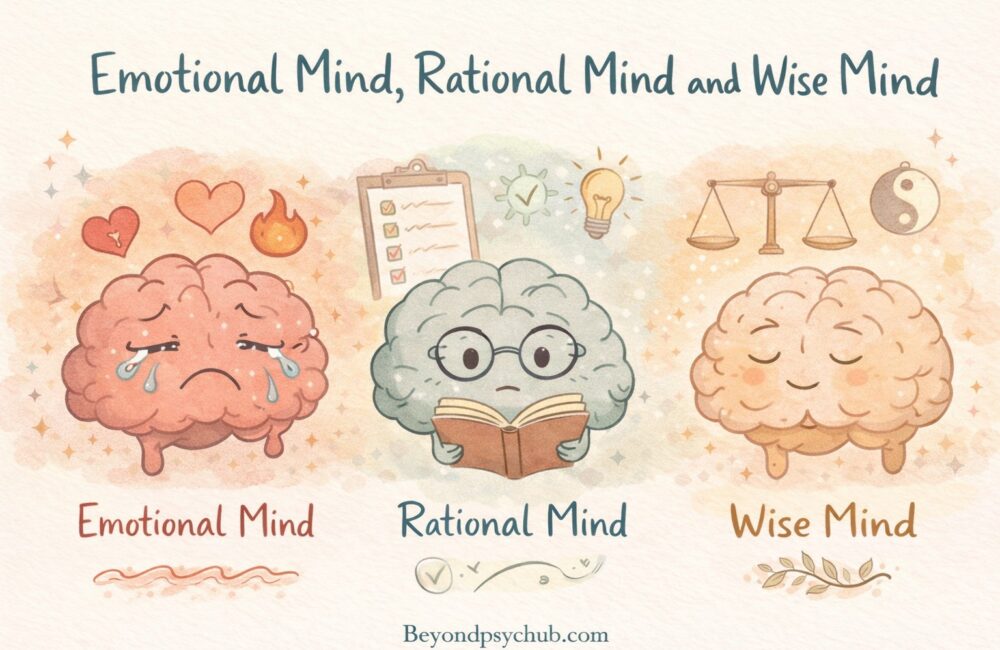

Emotion mind, reasonable mind, and wise mind are three teaching concepts used in Dialectical Behavior Therapy (DBT). They are not three separate brain regions, diagnoses, or fixed personality types. Instead, they offer a simple way to notice whether a decision is being led mainly by feelings, mainly by facts, or by an integration of emotion, evidence, values, and context.
This distinction matters because strong emotions can narrow attention, while detached analysis can overlook needs, relationships, and personal values. Wise mind does not ask you to eliminate either one. It helps you pause long enough to use both.
What Are the Three States of Mind in DBT?
| DBT concept | Main focus | Possible strength | Possible blind spot |
|---|---|---|---|
| Emotion mind | Feelings, urges, mood, and immediate needs | Signals what matters and helps you respond quickly | High arousal may encourage impulsive or short-term choices |
| Reasonable mind | Facts, logic, planning, and practical details | Supports analysis and problem-solving | May discount emotions, relationships, or values |
| Wise mind | Emotion and reason considered together | Supports a more grounded and effective response | Can be confused with an unexamined “gut feeling” |
Marsha Linehan, the psychologist who developed DBT, described these concepts in DBT skills training. The standard term is reasonable mind, although people often search for “rational mind.” Wise mind is part of DBT’s mindfulness module and represents a dialectical—or both-and—approach: feelings are real and worthy of attention, and facts still matter. [1]
Scientific accuracy note: This is a therapeutic framework, not a neuroscientific map. Research shows that emotion and cognition interact across overlapping brain systems; the popular idea of a purely “emotional brain” fighting a separate “rational brain” is too simple. [2]
What Is Emotion Mind?
Emotion mind is the DBT term for moments when feelings and urges have the strongest influence on attention, interpretation, and action. This may happen during fear, anger, shame, grief, excitement, attraction, or joy. The emotion does not have to be negative.
Emotion mind is not automatically irrational or harmful. Emotions can alert you to danger, unfairness, loss, connection, or an unmet need. Problems are more likely when emotional intensity becomes so high that you act before checking the facts or considering consequences.
Example of emotion mind
You receive a short message from your manager: “Can we talk tomorrow?” Anxiety rises, your stomach tightens, and you immediately assume you are about to lose your job. You begin writing a defensive reply. The anxiety is real, but the conclusion is still a prediction rather than a confirmed fact.
When arousal is very high, it may help to regulate your body before trying to solve the problem. The DBT TIPP skills and simple grounding techniques are designed for this pause.
What Is Reasonable Mind?
Reasonable mind—sometimes called rational mind—focuses on facts, logic, rules, planning, and practical consequences. It is useful for comparing prices, following instructions, making a schedule, reviewing evidence, or calculating risk.
Reasonable mind also has limits. A choice can appear efficient on paper yet conflict with your health, relationships, identity, or long-term priorities. Logic depends on the information and assumptions you start with, so a calm thought is not always a complete or correct thought.
Example of reasonable mind
You compare two job offers only by salary and commute time. One clearly wins on those numbers, so you tell yourself that stress, workplace culture, and meaningful work are irrelevant. Your calculation may be accurate, but your decision is missing information that matters to your well-being.
What Is Wise Mind?
Wise mind is the DBT practice of bringing emotional information and reasonable analysis together, then choosing an effective action that fits the situation and your values. It is not perfect certainty, constant calm, or a mystical answer. Sometimes wise mind simply means making the best available choice while accepting that uncertainty remains.
Mindfulness helps create space between an experience and a response. If this is new to you, start with the basics of what mindfulness is and how it works. The aim is to observe thoughts, emotions, and body sensations without immediately treating each one as a command.
Example of wise mind
Returning to the manager’s message, you acknowledge, “I feel anxious and I want reassurance.” You then check the facts: the message gives no reason for the meeting, your recent feedback was satisfactory, and many explanations are possible. You decide to reply politely, write down your questions, and postpone further conclusions until the conversation. The anxiety has not vanished; it is no longer making the whole decision.
What Does Research Actually Support?
The evidence needs careful wording. Research supports DBT as a structured psychotherapy for some clinical problems, especially those involving severe emotion dysregulation, self-harm, suicidal behavior, and borderline personality disorder (BPD). The 2024 American Psychiatric Association guideline recommends a structured psychotherapy supported by research for BPD, with treatment selected collaboratively for the individual. [3]
A 2020 Cochrane review found that psychological therapies, including DBT, may help people with BPD, but many comparisons were based on low- or very-low-certainty evidence. [4] A 2021 meta-analysis of 21 adolescent studies found DBT for adolescents showed benefits for self-harm and suicidal ideation, while also noting the need for more high-quality trials. [5]
Research on relevant skills is also promising but should not be stretched too far. A 2024 study of 75 outpatients with BPD found that greater nonjudgment and body awareness during mindfulness skills training predicted better emotion regulation the following week. The study examined a treatment group without a randomized comparison, so it suggests a mechanism rather than proving one. [6]
A meta-analysis published online in 2024 reviewed 110 studies involving 8,105 participants and found a small average effect of mindfulness-based strategies on emotional responses. The studies were varied and showed possible publication bias, so this finding does not prove that a brief Wise Mind exercise will produce the same benefit. [7]
Research also suggests that flexible regulation may matter more than labeling one strategy as universally “good.” In two 2024 daily-life studies in the United States and China, greater sensitivity to context and access to a useful range of strategies were associated with lower momentary distress. Because these were observational associations, they do not establish cause and effect or validate Wise Mind itself. [8]
Bottom line: Wise mind is a clinically established DBT teaching tool, but researchers have not validated emotion mind, reasonable mind, and wise mind as three measurable biological states. There is also limited research on Wise Mind as a stand-alone exercise. Its value is as a practical way to organize attention and choices within a broader skills-based approach.
How to Access Wise Mind: A Five-Step Practice
Use this exercise for ordinary decisions, conflicts, urges, or stressful moments. If you are in immediate danger or a mental health crisis, seek urgent support instead of relying on a self-help exercise.
1. Pause before acting
If it is safe, delay the message, purchase, confrontation, or major decision. Take one slow, comfortable breath and feel your feet or another point of contact. A pause of even 30 seconds can create room to observe what is happening.
2. Name emotion-mind information
- What emotion am I noticing?
- How intense is it from 0 to 10?
- What urge, body sensation, or need comes with it?
Use descriptive language: “I notice fear and an urge to escape,” rather than “Everything is ruined.” The RAIN mindfulness technique offers another structured way to recognize and allow an emotion.
3. Gather reasonable-mind information
- What facts can I verify?
- What am I assuming or predicting?
- What are the likely short- and long-term consequences?
- What information is still missing?
This fact-checking step is especially useful when anxiety is affecting decision-making.
4. Ask what fits your values and context
Consider what matters here: safety, honesty, health, respect, financial stability, connection, or another value. Then ask, “What response acknowledges my feelings, fits the facts, and moves me toward the person I want to be?” Values guide direction; they do not guarantee a comfortable choice.
5. Choose one effective next step
Your next step might be asking a question, setting a boundary, waiting for more information, making a small plan, or seeking support. “Effective” means suited to the goal and situation—not perfect. Review the result and adjust. Healthy self-regulation skills grow through repeated practice and feedback.
If reality cannot be changed immediately, wise mind may include acceptance alongside action. Radical acceptance in DBT means acknowledging present reality; it does not mean approving of harm or giving up on change.
Common Myths About Wise Mind
Myth 1: Emotion mind is bad
Fact: Emotions carry information and motivate action. The goal is to notice them without automatically obeying every urge.
Myth 2: Wise mind means staying calm
Fact: You can make a wise-mind choice while still feeling afraid, angry, or sad. Regulation is not the same as emotional numbness.
Myth 3: Reasonable mind is always correct
Fact: Analysis can be based on incomplete data, hidden assumptions, or goals that ignore well-being and relationships.
Myth 4: Wise mind is the same as gut instinct
Fact: Intuition can reflect experience, but it can also reflect fear, habit, or bias. Wise mind includes checking facts, context, consequences, and values.
Myth 5: A Wise Mind worksheet replaces therapy
Fact: Reading about one DBT skill is not the same as receiving comprehensive DBT, which may include individual therapy, group skills training, coaching, and a clinician consultation team.
When to Seek Professional Support
Self-help practice may be useful for everyday stress, but contact a qualified mental health professional if intense emotions, impulsive behavior, dissociation, substance use, self-harm, or relationship conflict repeatedly interferes with daily life. A clinician can assess what is happening and discuss treatments suited to your needs. This overview of psychotherapy and counselling can help you understand where to begin.
Urgent warning: If you may harm yourself or someone else, contact local emergency services or a crisis service now. Do not wait for a Wise Mind exercise to reduce the risk.
Frequently Asked Questions
Is wise mind a real psychological concept?
Yes. Wise mind is an established teaching concept in DBT. However, it is not a diagnosis, brain region, or independently proven biological state.
What is the difference between rational mind and reasonable mind?
They usually refer to the same idea in popular explanations. “Reasonable mind” is the standard DBT term; “rational mind” is a common alternative used in searches and everyday language.
Can emotions be logical?
Emotions often make sense in light of your interpretation, history, and needs. They are important data, but they are not always proof that your interpretation is accurate or that an urge is safe to follow.
How do I know I am in wise mind?
There is no objective test. Signs may include recognizing your feelings, checking facts, considering values and consequences, tolerating some uncertainty, and choosing an action that fits your longer-term goals.
Can I use wise mind when I am very upset?
Yes, but you may need to lower physical arousal first with a safe distress-tolerance or grounding skill. If there is immediate danger, prioritize safety and professional or emergency support.
Is wise mind only for people with BPD?
No. Anyone can use the framework as a reflection tool. That does not mean every person needs DBT or that the exercise has been equally studied for every mental health condition.
How long does it take to develop wise mind?
There is no fixed timeline. The goal is not to remain in wise mind all the time. Regular mindfulness, fact-checking, and reflection can make the pause easier to access, while complex patterns may benefit from therapist-guided practice.
Key Takeaways
- Emotion mind, reasonable mind, and wise mind are DBT teaching concepts—not three literal parts of the brain.
- Emotion mind offers information about feelings and needs; reasonable mind offers facts and analysis.
- Wise mind considers emotion, evidence, context, values, and consequences together.
- DBT has research support for certain clinical problems, but the Wise Mind exercise has limited stand-alone evidence.
- Pause, name the emotion, check the facts, identify what matters, and choose one effective next step.
References
- Linehan, M. M. (2025). DBT Skills Training Manual, revised edition. Guilford Press.
- Pessoa, L. (2015). The neurobiology of emotion-cognition interactions. Behavioral and Brain Sciences, 38, e71.
- Keepers, G. A., et al. (2024). The American Psychiatric Association practice guideline for the treatment of patients with borderline personality disorder. American Journal of Psychiatry, 181(11), 1024–1028.
- Storebø, O. J., et al. (2020). Psychological therapies for people with borderline personality disorder. Cochrane Database of Systematic Reviews, 5, CD012955.
- Kothgassner, O. D., et al. (2021). Efficacy of dialectical behavior therapy for adolescent self-harm and suicidal ideation: A systematic review and meta-analysis. Psychological Medicine, 51(7), 1057–1067.
- Schmidt, C., et al. (2024). How does mindfulness skills training work to improve emotion dysregulation in borderline personality disorder? Borderline Personality Disorder and Emotion Dysregulation, 11, 22.
- Raugh, I. M., Berglund, A. M., & Strauss, G. P. (2025). Implementation of mindfulness-based emotion regulation strategies: A systematic review and meta-analysis. Affective Science, 6, 171–200.
- Chen, M. S., et al. (2024). Emotion regulation flexibility and momentary affect in two cultures. Nature Mental Health, 2, 450–459.