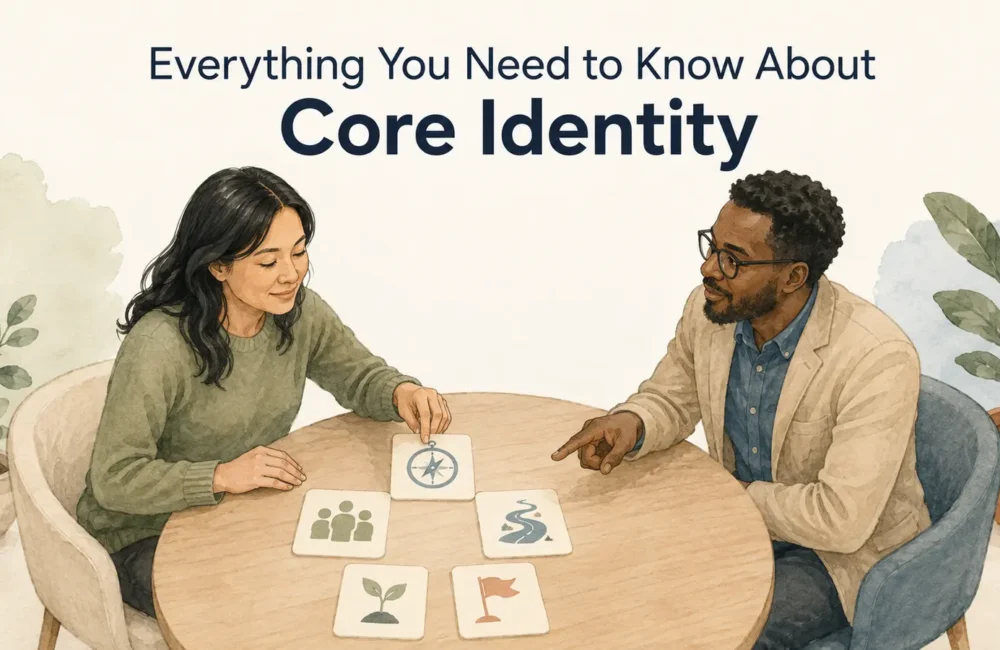

Core identity is a practical way to describe the values, commitments, roles, relationships, strengths and life-story themes you use to answer three questions: Who am I? What matters to me? How do I want to act? It can provide continuity without becoming a rigid definition. In coaching, the aim is not to uncover one hidden “true self,” but to build a clearer, evidence-based and revisable understanding of yourself.
Research review date: August 2026.
Advertising and partnership disclosure: This article contains no paid placement at the time of publication. Beyond Psychub may consider future partnerships with responsible coaching education providers, values-reflection tools, journals and goal-planning platforms. Any sponsorship must be clearly labelled and cannot control the evidence, conclusions or editorial review.
Educational note: This is a coaching and personal-development guide, not a diagnostic tool or a substitute for medical or mental health care. Coaching can support reflection, choices and goal-directed action; it does not diagnose or treat health conditions. Seek an appropriately qualified professional if identity questions are accompanied by significant distress, impaired daily functioning or safety concerns.
On This Page
Key Takeaways
- “Core identity” is coaching shorthand. Research more often examines self-concept clarity, identity commitments, social identity, narrative identity, values and possible selves.
- Identity has continuity and flexibility. Some commitments endure, while roles, priorities and self-descriptions can change across life stages and cultures.
- Clarity is not the same as certainty or self-esteem. A clear self-view can still be inaccurate, and healthy clarity leaves room for new evidence.
- Actions matter. A 2025 meta-analysis found a substantial association between identity and habit in the health behaviours studied, but the direction may run both ways.
- Coaching should convert reflection into experiments. Values, stories and goals become useful when they inform specific, observable choices.
What Is Core Identity?
In this guide, core identity means the relatively enduring—but revisable—pattern of values, commitments, roles, relationships, strengths and story themes through which you understand yourself and choose how to act. “Relatively enduring” matters: identity can give you continuity without requiring you to behave identically in every situation.
Core identity is not a single standardized construct or score used across psychological science. It is a useful umbrella for several researched ideas. Your self-concept contains beliefs about your traits, roles and values. Self-concept clarity concerns how clearly, consistently and confidently those beliefs are organized. Identity research also examines commitments, exploration, group belonging and the life story that connects past, present and future.
That distinction prevents two common errors. First, being clear about yourself does not prove that every belief is accurate. Second, changing a role, goal or opinion does not mean you have “lost yourself.” Sometimes revision is evidence of learning.
What Core Identity Includes
Values
Values are chosen qualities of action—such as honesty, curiosity, care, courage or fairness—not trophies to complete. A value becomes informative when you can describe what it looks like in behaviour. “I value learning” is broad; “I ask one thoughtful question before defending my view” is observable.
Commitments and standards
Commitments are the directions, promises and responsibilities you choose to keep returning to. They may concern family, work, community, learning or a sense of purpose. Unlike a slogan, a commitment creates a decision rule: “When time is limited, what receives my attention?”
Roles, relationships and belonging
Identity is not only individual. Family, friendship, work, culture, faith, language, place and communities can all answer part of “Who are we?” Multiple identities are normal. The coaching task is usually integration and choice—not forcing every role into sameness.
Strengths and recurring capabilities
Strengths describe capacities you can apply, such as perspective, persistence or social intelligence. They inform identity best when supported by examples rather than flattering labels. A list of positive character traits can supply vocabulary, but feedback and behaviour provide better evidence.
Narrative identity
People make meaning by linking remembered events into a life story: what changed, what was learned, who helped, and what remains unfinished. A 2024 nine-year study of 157 late-midlife adults found that themes of agency and connection in annual challenge narratives were associated with well-being over time beyond personality traits. It was observational, so it does not prove that rewriting a story produces the outcome.
Future direction
Identity also contains possible selves: the person you hope, expect or fear becoming. A useful future self is neither fantasy nor prediction. It guides the next experiment and can be translated into personal goals, skills and support.
What core identity is not
- A fixed essence formed only in childhood
- A job title, relationship status or public brand
- A diagnosis or a measure of worth
- One personality-test result
- A requirement to feel certain in every domain
- Permission to ignore feedback, responsibilities or consequences
What Does Current Research Say?
The research supports identity as a dynamic system rather than a motivational slogan. It also calls for restraint. A comprehensive 2026 review described self-concept clarity as the structure of self-knowledge—not its positivity or accuracy—and identified unresolved causal direction, heavy reliance on self-report and limited cross-cultural validation. Its practical conclusion is especially useful for coaching: optimal clarity is likely a balance between coherence and openness to revision.
| Evidence | What was found | Coaching interpretation |
|---|---|---|
| 2026 integrative review | Self-concept clarity is related to adjustment, but much evidence is self-reported and causal ordering remains unresolved. | Seek clear, testable self-descriptions; do not treat confidence as proof. |
| 2025 identity-intervention meta-analysis | Across 36 youth studies (N=4,529), effects were small to moderate for personal identity (d=0.48), social identity (d=0.36) and ethnic identity (d=0.23). | Structured identity reflection can help, but these studies do not establish the effect of one-to-one adult life coaching. |
| 2025 self-concordant-goals meta-analysis | Across 77 studies and 978 effects, goals pursued for autonomous, personally endorsed reasons were associated with effort, attainment, need satisfaction and well-being. | Ask whether a goal is chosen or mainly driven by approval, guilt, reward or pressure. |
| 2025 habit–identity meta-analysis | In 19 articles with 13,340 participants, identity and habit were substantially correlated (r=0.55) for physical activity, eating and drinking behaviours. | Use repeated action as identity evidence, while remembering that causality may run in both directions and the review covered limited behaviours. |
| 2026 behaviour-identity review | Across 20 physical-activity or smoking studies, identity-focused interventions had mixed results; nearly half reported positive effects, while others found no significant difference. | A compelling future-self exercise is not enough by itself; planning, context and follow-through matter. |
A separate 2025 systematic review found only 10 eligible studies on identity development and well-being from 1990–2024. Identity commitment was related to development, but findings for in-depth exploration were inconsistent and the link with well-being was not fully clear. This is why a responsible coach should not promise that “finding your identity” automatically produces happiness or success.
Research also varies by age and culture. A 2026 review of adolescent identity emphasizes that commitments and group memberships develop through ongoing exploration and reconsideration. A 2024 study of 2,001 Chinese adolescents linked greater self-concept clarity with hope and subjective well-being across time, but it remains an observational study in a particular population—not proof that a coaching exercise caused the changes.
How Core Identity Develops and Changes
Identity develops through an ongoing exchange between the person and the environment. Family messages, cultural expectations, opportunities, feedback, group membership, successes, disappointments and role transitions all contribute. You are neither a blank slate nor a finished product.
- Exploration: considering roles, beliefs, groups and future directions.
- Commitment: choosing what deserves sustained effort and responsibility.
- Enactment: turning a self-description into repeated behaviour.
- Feedback: noticing results, consequences and other people’s credible observations.
- Revision: retaining, refining or releasing a description when evidence changes.
Transitions—graduation, parenthood, relocation, career change, retirement or a change in community—can temporarily make identity feel less clear because familiar roles no longer organize daily life. That uncertainty can be productive. Psychological flexibility helps you carry values into a new context without clinging to an outdated label.
How Can Coaching Help With Core Identity?
Identity-focused coaching is a structured conversation about present choices and future action. A coach can help you separate inherited expectations from chosen commitments, identify conflicts between roles, turn abstract values into behaviour, and review the evidence from small experiments. The coach should facilitate your thinking rather than prescribe who you ought to be.
Useful coaching questions include:
- Which description of yourself is supported by repeated evidence?
- Which goal would still matter if nobody applauded it?
- Which role is important, and which has become too dominant?
- What value is involved in this decision, and what would that value look like tomorrow?
- What information might change your current view?
- What is the smallest safe experiment that would teach you something?
For goal work, a coach might use the GROW coaching model or a goal-readiness assessment. These tools structure thinking; they do not certify that a chosen identity is correct.
The CORE Identity Coaching Framework
The following CORE framework is a practical editorial model for reflection, not a validated psychological test.
| Step | Coaching focus | Useful output |
|---|---|---|
| C — Clarify | Values, chosen commitments and current priorities | Three values defined as observable actions |
| O — Observe | Roles, stories, strengths, pressures and contradictory evidence | A balanced identity map, not just positive labels |
| R — Run experiments | Small, safe, identity-consistent behaviours in a real context | One action, one cue and one review date |
| E — Evaluate and edit | Results, effort, fit, trade-offs and new information | Keep, refine or release the working description |
This sequence keeps identity work grounded. It replaces “I must prove who I am” with “I can gather evidence about how I want to live.” It also makes room for learning, unlearning and relearning.
A Practical Core Identity Audit
Set aside 30–45 minutes. Use a notebook or private document, and answer with examples rather than idealized adjectives.
1. Inventory your current “I am” statements
Write 10 endings to “I am…” Mark each as a role, trait, value, group, skill, commitment or story. Then ask: Which statements are descriptive? Which are aspirations? Which were assigned by someone else?
2. Translate values into behaviour
Choose three values. For each one, complete: “When I live this value, another person could observe me…” If the answer cannot be observed, make it more specific.
3. Build an evidence ledger
For each identity claim, record evidence for it, evidence that complicates it and the context in which it appears. “I am dependable” becomes stronger and more honest when you can name both kept commitments and situations where your system failed.
4. Separate chosen commitments from inherited scripts
Ask where each expectation came from, what it protects or enables, and whether you still endorse it. An inherited value is not automatically wrong; it becomes yours when you examine and choose it.
5. Map role tensions
Identify two roles competing for time, loyalty or energy. Instead of asking which role is the “real you,” define a boundary or decision rule that honours the most relevant commitments in that season.
6. Draft a working identity statement
Try: “I am someone who values _____. I express it by _____. In this season, I am committed to _____. I am willing to revise this as I learn.” A working statement is more useful than a permanent verdict.
7. Run a 14-day identity experiment
Choose one action small enough to repeat. Define the cue, minimum version and review date: “After I close my laptop on weekdays, I will spend ten minutes on the course that supports my commitment to learning.” Use a habits and consistency assessment to review the system rather than judging your character after one missed day.
Core Identity Alignment: Signals and Coaching Questions
Alignment is not constant comfort. A value-consistent choice can be difficult, and competing values can make reasonable options feel mixed. Use these patterns as prompts, not scores.
| Area | Possible alignment signal | Coaching question |
|---|---|---|
| Decisions | You can explain the trade-off in terms of chosen priorities. | Which value is most relevant here—not simply most important in general? |
| Goals | The reason feels personally endorsed even when the work is demanding. | Would this goal matter without applause, guilt or comparison? |
| Roles | You can adapt across roles without feeling that one must erase the others. | What principle connects these roles, and where do they need different boundaries? |
| Habits | Your environment makes the desired action easier to repeat. | What cue, support or smaller version would improve follow-through? |
| Self-talk | Your language is specific, evidence-based and open to revision. | What fact supports this claim, and what fact complicates it? |
| Feedback | You can consider credible feedback without handing over authorship of your identity. | What should you accept, test or decline—and why? |
Common Core Identity Coaching Mistakes
- Confusing confidence with accuracy: a strongly held description still needs evidence.
- Turning a test into a verdict: inventories can start a conversation but should not restrict opportunities.
- Ignoring culture and relationships: autonomy is not the only meaningful value; belonging and responsibility also shape identity.
- Using affirmations without action: repeated behaviour, context and feedback make a claim testable.
- Demanding perfect consistency: different roles can express the same value differently.
- Making a goal a measure of worth: a failed experiment is information about strategy, timing or fit—not proof of a defective self.
- Overlooking power and constraints: not every blocked goal reflects motivation; money, caregiving, discrimination, access and time shape available choices.
A useful standard is progress over perfection: specific action, honest review and proportionate revision.
How to Choose a Responsible Identity Coach
- Ask about training, supervision, experience and a clear scope of practice.
- Expect transparent fees, confidentiality terms, record handling and cancellation policies.
- Look for collaborative goal setting and regular progress reviews.
- Check that the coach distinguishes coaching from diagnosis and treatment and can refer appropriately.
- Avoid guaranteed transformation, pressure to disclose more than is necessary, or claims that one proprietary test reveals your “real identity.”
- Choose someone who can discuss cultural context, role constraints and conflicts of interest without imposing their values.
Ethical Partnership and Advertising Opportunities
This topic offers a natural fit for clearly labelled collaborations with credentialed coach-training organisations, evidence-informed values-card or reflection-tool publishers, privacy-respecting goal-planning apps, coaching journals, career-development platforms and learning providers. Useful sponsored content could demonstrate a structured reflection exercise, compare transparent product features or fund an expert-reviewed worksheet.
Poor-fit advertising includes quizzes marketed as diagnoses, products that promise to reveal a permanent identity in minutes, undisclosed high-ticket coaching funnels, guaranteed outcomes, or apps that collect sensitive reflection data without plain-language privacy controls. Commercial partners should not select sources, suppress limitations or influence the article’s conclusions. Organisations interested in a transparent collaboration can review the Write for Us information.
Frequently Asked Questions
Is core identity fixed?
No. Some values and commitments may remain stable for years, but identities develop through exploration, roles, relationships, culture, transitions and behaviour. Healthy clarity is coherent enough to guide you and flexible enough to incorporate new evidence.
What is the difference between core identity and personality?
Personality usually refers to relatively broad patterns of thinking, feeling and behaviour. Core identity, as used here, emphasizes the meanings, values, roles, commitments and story through which you understand who you are. Personality may influence identity, but the terms are not interchangeable.
Can a person have multiple identities?
Yes. Professional, family, cultural, community and other identities can coexist. The useful question is whether you can integrate them, negotiate their demands and choose boundaries—not whether every role produces the same behaviour.
How do values relate to core identity?
Values describe qualities of action you want to embody. They influence identity when you choose them deliberately, define them behaviourally and use them to guide decisions. A value label without action provides little evidence.
How can coaching support core identity?
Coaching can structure reflection, challenge vague or inherited assumptions, identify value-aligned goals, design small experiments and review results. It should expand your authorship and choices, not tell you who to be.
How long does core identity work take?
There is no evidence-based universal timeline. You can draft a useful working statement in one session, but testing it across situations takes repeated action and review. Treat clarity as an iterative practice rather than a one-time discovery.
Is an online core identity quiz enough?
No single quiz can establish your core identity. A transparent, non-diagnostic tool may offer prompts, but compare the result with behaviour, context, feedback and your own considered commitments.
The Bottom Line
Core identity is most useful when treated as a working map: stable enough to guide choices, detailed enough to test and flexible enough to update. Begin with values and commitments, check them against roles and real behaviour, run a small experiment, and revise your description with humility. The goal of coaching is not a perfect label. It is clearer authorship of the next responsible action.
Research Sources
- Manchiraju, S. (2026). Self-concept clarity: A comprehensive and integrative review. Frontiers in Psychology, 17.
- Crocetti, E. (2026). Adolescent identity development processes, implications and interventions. Nature Reviews Psychology, 5, 441–457.
- Crocetti, E., et al. (2025; online first 2024). Promoting adolescents’ personal and social identities: A meta-analysis of psychosocial interventions. Identity, 25(2), 167–196.
- Sezer, B., et al. (2025). Goal motives, goal-regulatory processes, psychological needs, and well-being: A systematic review and meta-analysis. Motivation Science, 11(3), 259–276.
- Zhu, L., et al. (2025). The relationship between habit and identity in health behaviors: A systematic review and three-level meta-analysis. Applied Psychology: Health and Well-Being, 17(2), e70017.
- van Vliet, M. H., et al. (2026). The effect of identity-related interventions on physical activity- and smoking-related identities and behavior. Systematic Reviews, 15, 106.
- Guțu, S., & Golu, F. (2025). Identity development and well-being: A systematic review. Studia Doctoralia, 16(1).
- Xiang, G., et al. (2024). Evaluating a longitudinal multilevel mediation model of self-concept clarity, hope, and subjective well-being in adolescents. International Journal of Behavioral Development, 48(3).
- Lind, M., et al. (2024). Narrative identity, traits, and trajectories of depression and well-being: A 9-year longitudinal study. Psychological Science, 35(12), 1325–1339.