Explore the guidance, choose one manageable action and use the printable worksheet to record your ideas.
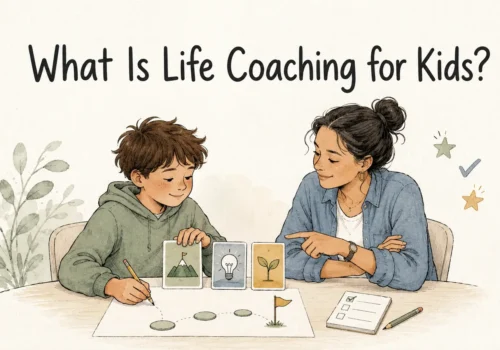
Building Confidence Through Small Actions is a free printable worksheet that helps children choose an everyday skill, plan a manageable step and reflect on practice. Designed for roughly ages 7–12, it includes three activity pages and a separate guide for coaches, educators and caregivers.
Download the confidence worksheet PDF
Format: four-page A4 PDF, approximately 76 KB. Print and write or draw by hand. It is not an interactive form; a PDF annotation app can also be used.
What is inside the confidence worksheet?
- Choose a skill: identify something the child wants to learn, why it matters and a previous learning experience.
- Plan a small action: choose a first step, practical support and a backup plan.
- Review practice: describe what happened, what helped and what to try next.
- Coach notes: facilitation, adaptations, privacy, safeguarding and research references.
Examples include packing a school bag, learning a game, asking for help or sharing an idea. Children can draw, speak their answers, use a scribe or skip a prompt. Completing a page is not a test of confidence.
How coaches can use it
- Gain caregiver consent where required and the child’s willing participation. Explain what will be shared and the limits of confidentiality.
- Invite the child to choose one safe, everyday skill. Allow about 10–15 minutes for planning, with flexibility for their needs.
- Help them find a small step they consider manageable. Offer a demonstration or shared practice if invited.
- Arrange a short opportunity to practise, then review what happened. Notice specific actions and strategies rather than ranking the child against others.
- Let the child repeat, simplify, change or pause the plan. Persistent difficulty may call for different teaching, an accommodation or additional support.
For example: “You checked your list and found the missing book. What helped you remember?” gives useful feedback about an action. A child does not need to feel confident before every attempt, and an unfinished attempt can still reveal what support is needed.
Advertising and partnership disclosure: BeyondPsychub may have commercial relationships with selected partners. These relationships do not determine this resource’s evidence-based conclusions or recommendations.
Our parent’s guide to life coaching for kids explains the broader coaching context. Adults looking for their own reflection tool can explore the separate general confidence-building worksheet.
Educational Note: This resource is for coaching and skill development. It is not intended for medical purposes and is not a diagnostic tool, psychological treatment or substitute for individualized professional care. It has not been clinically validated. Pause if the child becomes distressed and follow appropriate safeguarding procedures if harm or abuse is disclosed.
Research and limitations
Small, achievable goals are informed by Bandura and Schunk’s study of children’s arithmetic learning and self-efficacy. Its findings concern a specific learning context and do not prove that this worksheet improves confidence in every situation. Read the study.
Gunderson and colleagues found an association between early process praise and later motivational beliefs. This observational result does not establish causation. It informs the focus on specific actions and strategies, alongside practical help. Read the research.
UNICEF’s guidance for ages 6–10 supports age-appropriate independence and supportive caregiving. The worksheet is an original educational adaptation of these ideas, not a reproduction of a published assessment. Its age range and suggested timings are practical design choices, not validated cut-offs.
Originality review: The wording and examples were reviewed against the source material, with targeted web phrase searches. This limited review is not a comprehensive plagiarism-database check; no numerical plagiarism score is claimed.
References
- Bandura, A., & Schunk, D. H. (1981). Cultivating competence, self-efficacy, and intrinsic interest through proximal self-motivation. Journal of Personality and Social Psychology, 41, 586–598.
- Gunderson, E. A., et al. (2013). Parent praise to 1- to 3-year-olds predicts children’s motivational frameworks 5 years later. Child Development, 84, 1526–1541.
- UNICEF. Positive parenting tips for children aged 6–10. Accessed 12 September 2026.