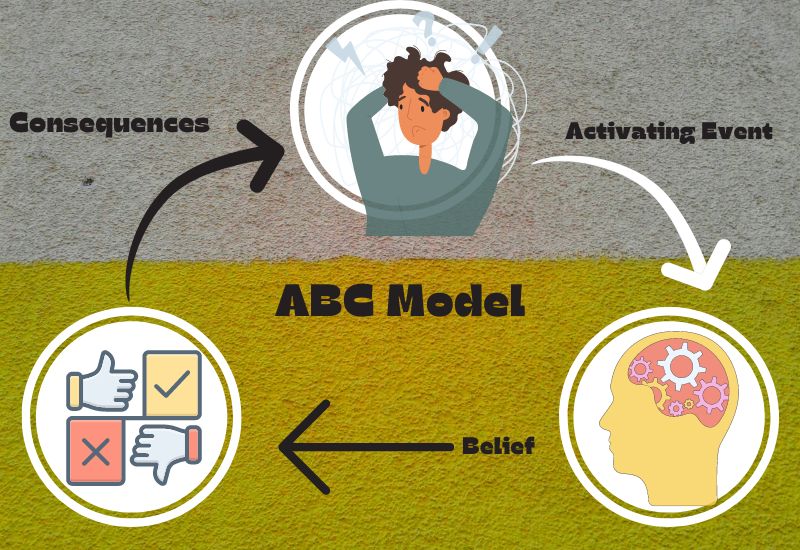

The ABC model in cognitive behavioral therapy is a simple framework for understanding why the same situation can affect two people in very different ways. It separates an experience into three parts: the activating event, the beliefs or interpretations attached to it, and the resulting emotional and behavioral consequences.
The model is most closely associated with Rational Emotive Behavior Therapy (REBT), developed by psychologist Albert Ellis in the 1950s. It also overlaps with the broader cognitive model used in CBT, which examines how thoughts, emotions, physical sensations, and actions interact.
The ABC model is not about forcing positive thoughts, denying painful circumstances, or blaming people for their distress. Instead, it helps identify where an interpretation may be rigid, incomplete, or unhelpful—and where practical action, acceptance, communication, or professional treatment may be needed.
What Does ABC Stand For?
| Letter | Meaning | Key question |
|---|---|---|
| A | Activating event or adversity | What happened? |
| B | Beliefs, thoughts, assumptions, or meaning | What did I tell myself about it? |
| C | Emotional, behavioral, and physical consequences | What did I feel and do next? |
The central idea is that an event does not always produce an emotional reaction in a direct, automatic way. A person’s interpretation often helps shape the intensity and type of response.
For example, imagine that a friend does not reply to a message.
- A: The friend has not replied for six hours.
- B: “They are angry with me. I must have done something wrong.”
- C: Anxiety, repeated checking, apologetic messages, and difficulty concentrating.
A different belief—“They may be busy, and I do not have enough information yet”—could lead to mild concern and a decision to wait. The situation has not changed, but the response has.
How the ABC Model Fits Within CBT and REBT
CBT is based on the idea that thoughts, beliefs, behavior, emotions, and physical reactions influence one another. Therapists help people notice automatic thoughts, evaluate them, solve problems, test predictions, and build new behavioral skills.
REBT places particular emphasis on rigid, extreme beliefs. Ellis proposed that distress is often intensified by demands such as:
- “I must perform perfectly.”
- “Other people must treat me fairly.”
- “Life must be easy and predictable.”
When these demands are not met, they may lead to:
- Awfulizing: “This is the worst thing that could happen.”
- Low frustration tolerance: “I cannot stand this.”
- Global self-rating: “I failed, so I am a failure.”
- Global rating of others: “They behaved badly, so they are completely bad.”
REBT aims to replace rigid demands with flexible preferences, such as: “I strongly want to succeed, but I do not have to succeed every time to have worth.”
For a broader introduction to therapy approaches, see Psychotherapy and Counselling: Differences and How to Get Started.
A: Activating Event
The activating event is the situation that occurred before the emotional or behavioral response. It can be external or internal.
External activating events
- Receiving criticism
- Making a mistake at work
- Being excluded from a gathering
- Experiencing conflict with a partner
- Seeing a trauma reminder
- Receiving an unexpected bill
Internal activating events
- A memory
- A physical sensation
- An intrusive thought
- A mental image
- A sudden change in mood
A useful description of A should be specific and factual. “My manager said the report needed more detail” is clearer than “My manager humiliated me.” The first describes what happened; the second already includes an interpretation.
B: Beliefs and Interpretations
Beliefs include automatic thoughts, assumptions, rules, predictions, and deeper ideas about oneself, other people, or the world.
They may include:
- “I am going to be fired.”
- “If someone disapproves of me, I am unlikable.”
- “I should never feel anxious.”
- “I cannot cope unless I know exactly what will happen.”
- “If I make one mistake, the whole project is ruined.”
In standard CBT, therapists often call recurring errors in thinking cognitive distortions. Common examples include catastrophizing, mind reading, all-or-nothing thinking, emotional reasoning, overgeneralization, and personalization.
However, not every distressing belief is inaccurate. A person may be facing real discrimination, danger, illness, abuse, financial hardship, or loss. In those situations, therapy should not reduce the problem to “thinking positively.” It may need to combine emotional coping with safety planning, advocacy, boundary-setting, medical care, or practical problem-solving.
C: Emotional, Behavioral, and Physical Consequences
Consequences include more than emotions. They may involve:
- Emotions: anxiety, sadness, shame, anger, guilt, disappointment, or relief
- Behavior: avoidance, reassurance seeking, arguing, withdrawing, procrastinating, checking, or problem-solving
- Physical reactions: muscle tension, rapid heartbeat, nausea, sweating, fatigue, or disturbed sleep
It is important to separate healthy painful emotions from unhelpful escalation. Sadness after a loss is not a thinking error. Concern before an exam can motivate preparation. Anger at unfair treatment may support assertive action.
REBT often distinguishes between:
- Healthy negative emotions: concern, sadness, regret, disappointment, and annoyance
- Unhealthy or excessive emotions: panic, hopelessness, self-hatred, rage, or paralyzing shame
The goal is not to feel happy about everything. It is to respond in a way that is proportionate, flexible, and consistent with one’s values.
The ABCDE Model
The extended model adds two steps:
- D — Disputation: examining and challenging an unhelpful belief
- E — Effective new belief or effect: developing a more balanced belief and observing the new emotional or behavioral result
Some versions add F for the new feeling or future action.
| Step | Example |
|---|---|
| A | I made an error during a presentation. |
| B | “Everyone thinks I am incompetent. I must never make mistakes.” |
| C | Shame, rumination, avoiding future presentations. |
| D | What evidence shows everyone judged me? Is perfection realistic? Does one error define my ability? |
| E | “The mistake was uncomfortable, but it does not define me. I can correct it and prepare differently next time.” |
How to Challenge a Belief
A therapist may use several types of questions.
Evidence questions
- What facts support this thought?
- What facts do not support it?
- Am I confusing a possibility with a certainty?
Logic questions
- Does one mistake logically mean I am a failure?
- Does disapproval from one person define my worth?
- Am I turning a preference into a demand?
Usefulness questions
- Does this belief help me solve the problem?
- What does believing it lead me to do?
- Is it helping me act according to my values?
Perspective questions
- What would I say to a friend in the same situation?
- How might I view this in six months?
- What is the most balanced explanation?
The replacement thought should be believable—not artificially cheerful. “Nothing bad will happen” is usually less useful than “I cannot know the outcome, but I can prepare and cope with uncertainty.”
Worked Example: Anxiety Before a Meeting
A: You are asked to present an idea to senior colleagues.
B: “I must sound confident. If I hesitate, everyone will know I do not belong here.”
C: Strong anxiety, rapid heartbeat, overpreparing, poor sleep, and considering calling in sick.
D:
- Is complete confidence required for a useful presentation?
- Have competent people ever hesitated?
- Does one imperfect moment prove that I do not belong?
- Would avoiding the meeting help my long-term confidence?
E: “I would prefer to speak smoothly, but I do not need to be perfect. I can use notes, pause, and answer what I know.”
Behavioral experiment: Give the presentation using brief notes and record what actually happens. Compare the prediction—“Everyone will reject the idea”—with the observed result.
For more on applying CBT to anxious thoughts, read CBT for Anxiety: How Cognitive Behavioral Therapy Helps.
Worked Example: Relationship Conflict
A: Your partner responds briefly after work.
B: “They are losing interest in me. If they loved me, they would always be warm.”
C: Fear, anger, repeated questioning, and an argument.
D: Are there other explanations? Is constant warmth a realistic requirement? What information could I gather through calm communication?
E: “Their brief response may reflect stress. I can ask directly rather than assume rejection.”
The model does not mean dismissing repeated disrespect. If a relationship includes manipulation, threats, coercion, or violence, safety and professional support matter more than reframing the situation.
Worked Example: Low Self-Esteem After a Mistake
A: You miss an important deadline.
B: “I am unreliable and useless.”
C: Shame, withdrawal, procrastination, and avoidance of the manager.
D: Does one behavior define the whole person? What factors contributed? What repair is possible?
E: “Missing the deadline was a meaningful mistake, but it does not define my worth. I can acknowledge it, propose a correction, and improve my planning.”
Related reading: Signs of Low Self-Esteem and How to Overcome Self-Doubt.
A Practical ABC Worksheet
- Describe A factually. Write what happened, where, and when.
- Rate the emotion. Name it and rate its intensity from 0 to 100.
- Identify B. Record the exact automatic thought or rule.
- Record C. Note emotions, body sensations, urges, and actions.
- Look for patterns. Is there catastrophizing, demandingness, mind reading, or global self-judgment?
- Dispute carefully. Review evidence, logic, usefulness, and alternatives.
- Create a balanced belief. Use flexible, realistic language.
- Choose an action. Communicate, solve a problem, test a prediction, tolerate discomfort, or seek support.
- Re-rate the emotion. The goal is not necessarily zero distress; even a modest reduction can improve functioning.
What Therapists Add Beyond a Worksheet
A trained therapist does more than help someone replace one sentence with another. Therapy may include:
- Identifying deeper core beliefs and repeated life patterns
- Distinguishing realistic danger from anxious prediction
- Behavioral experiments and exposure exercises
- Problem-solving and communication training
- Reducing avoidance, rumination, and reassurance seeking
- Building emotional regulation and self-compassion
- Adapting treatment for trauma, ADHD, autism, chronic illness, or cultural context
- Monitoring symptoms and safety
CBT is structured and collaborative. It generally includes goals, between-session practice, review of progress, and adjustments based on what works.
Benefits of the ABC Model
The ABC model may help people:
- Separate facts from interpretations
- Recognize automatic thoughts
- Understand links between thinking and behavior
- Reduce rigid self-judgment
- Respond more thoughtfully during conflict
- Identify avoidance and unhelpful coping patterns
- Develop tolerance for uncertainty and frustration
- Choose actions based on values rather than immediate emotion
A 2018 meta-analysis found that REBT produced moderate improvements in psychological outcomes and irrational beliefs. A 2024 systematic review also found generally favorable changes, while noting that the methodological quality of much of the evidence outside sport and exercise settings was limited. This means the approach is supported, but claims should remain proportionate.
Limitations and Misconceptions
The ABC model does not prove thoughts cause every problem
Biology, trauma, poverty, discrimination, relationships, medical illness, sleep, and environmental stress also affect mental health.
It is not simply “think positive”
Balanced thinking may still include disappointment, grief, anger, or concern. Accuracy and flexibility are more important than optimism.
It does not excuse harmful behavior
Understanding one’s interpretation does not remove another person’s responsibility for abuse, discrimination, neglect, or misconduct.
It may not be enough on its own
Severe depression, PTSD, OCD, psychosis, eating disorders, substance use disorders, or suicidal thinking usually require a full assessment and condition-specific care.
Overanalyzing can become another problem
People prone to rumination or OCD may turn thought records into repeated checking. A therapist can help keep the exercise brief and action-focused. See How to Stop Ruminating Thoughts.
Common Myths
Myth: Events never cause emotions
Events clearly matter. The model says interpretation is one important part of the response, not the only cause.
Myth: Negative emotions are irrational
Sadness, fear, anger, guilt, and grief can be healthy and appropriate. The focus is on whether the response is proportionate and helpful.
Myth: Every thought must be challenged
Some thoughts can simply be noticed and allowed to pass. Others require practical action rather than cognitive restructuring.
Myth: A rational belief is always positive
A rational belief may be uncomfortable: “The relationship may end, and that would hurt, but I could seek support and cope.”
Myth: The ABC model replaces therapy
It is a useful self-monitoring tool, but complex or severe symptoms may require professional care.
When to Seek Professional Help
Consider speaking with a qualified mental health professional when thoughts or emotions:
- Cause persistent distress
- Interfere with work, sleep, relationships, or self-care
- Lead to panic, compulsions, substance use, or severe avoidance
- Are linked to trauma, abuse, or intrusive memories
- Include hopelessness, self-harm, or suicidal thinking
Our guide to signs it may be time to see a therapist provides additional guidance.
Frequently Asked Questions
Who developed the ABC model?
Albert Ellis developed the model as part of Rational Emotive Behavior Therapy in the 1950s.
Is the ABC model part of CBT?
It is most directly associated with REBT, one of the early cognitive behavioral therapies. It is also compatible with the broader CBT cognitive model.
What is the difference between A and B?
A is the event or trigger. B is the meaning, prediction, rule, or belief attached to it.
What does C include?
C includes emotional, behavioral, and physical consequences—not only feelings.
What are D and E?
D means disputing or evaluating an unhelpful belief. E is the effective new belief and resulting response.
Can I use the ABC model by myself?
Yes, for everyday stress and self-reflection. A therapist may be helpful when patterns are severe, repetitive, trauma-related, or difficult to identify.
Does the model work for anxiety?
It can help identify catastrophic predictions, avoidance, and demands for certainty. Clinical anxiety may also require exposure, behavioral change, medication, or other treatment.
Can the ABC model help with anger?
It can identify rigid demands, perceived disrespect, and hostile interpretations that intensify anger. It should be combined with communication, regulation, and safety skills where needed.
References
- Beck Institute: What Is Cognitive Behavioral Therapy?
- David D, et al. Fifty Years of REBT: Systematic Review and Meta-Analysis
- King R, et al. Systematic Review of REBT Interventions
- Turner MJ. REBT, Irrational and Rational Beliefs, and Mental Health
- Ziegler DJ, Leslie YM. A Test of the ABC Model Underlying REBT
- NICE: Depression in Adults—Treatment Recommendations
Key Takeaways
- A is the activating event, B is the belief or interpretation, and C is the emotional, behavioral, and physical consequence.
- The model is rooted in REBT and overlaps with the wider CBT cognitive model.
- Its purpose is balanced, flexible thinking—not forced positivity.
- Painful emotions can be healthy and appropriate.
- The ABCDE extension adds disputation and an effective new belief.
- Behavioral experiments help test predictions in real life.
- Real danger, abuse, discrimination, grief, and medical problems require practical responses as well as coping skills.
- Severe or persistent symptoms should be assessed by a qualified professional.
This article is for education only and does not replace diagnosis or individualized treatment from a qualified mental health professional.