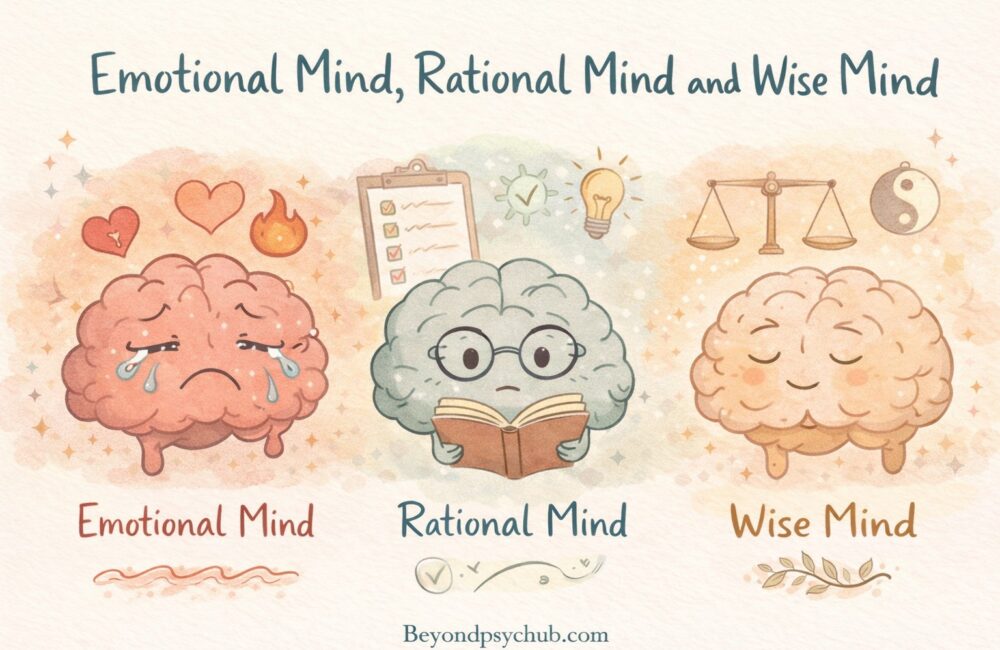

Human behavior and decision-making are shaped by three primary states of mind: Emotional Mind, Rational Mind, and Wise Mind. Understanding the unique characteristics a—and how they interact— is crucial for building self-awareness, emotional intelligence, and the ability to make balanced, effective decisions.
This framework, widely used in Dialectical Behavior Therapy (DBT), helps individuals recognize why they think, feel, and act the way they do, especially during emotionally charged situations.
What Is the Emotional Mind?
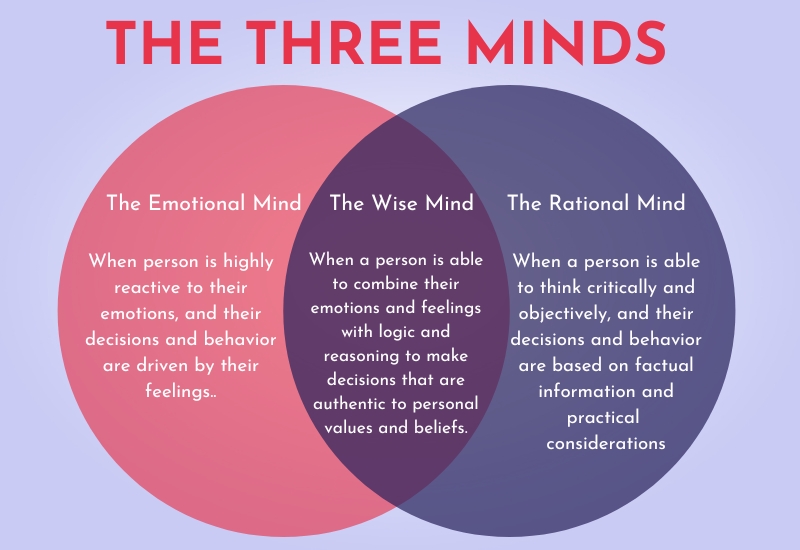
An emotional mindset is a state of mind in which emotions and feelings are more dominant than logical thought and reasoning. Often described as the “hot” side of the mind, people with an emotional mindset tend to be highly reactive to their emotions, and they often make decisions based on their feelings rather than considering the practical aspects of a situation.
They may be highly sensitive and easily influenced by their emotional experiences, which can lead to impulsive behavior and poor decision-making. The emotional mind is responsible for aspects such as poetry, music, art, fashion, etc.; it is the passionate side of the mind.
Although an emotional mindset is not necessarily a bad thing, it is often viewed negatively and carries social disadvantages. Our emotional reason is responsible for feelings such as love, fear, anger, etc.
Example of Emotional Mind
An example of an emotional mindset is when a person makes a decision solely based on their emotions and feelings rather than a logical analysis of the situation. such as purchasing an expensive item despite knowing it exceeds one’s budget. In this case, their emotions are the driving force behind their decision, rather than practical considerations such as their budget or financial responsibilities.
Another example is quitting a job impulsively due to feeling unappreciated, without considering financial stability or future employment.
What Is the Rational Mind?
A rational mind, also known as the reasonable mind, guides us into thinking over a situation clearly without feelings getting in the way. Take the pervasive example of people in love. A person in love would not understand how you can see their partner in the wrong, even though the partner would be wrong at times. Because they are using their emotional mind while you are using your rational mind. In our world, being of sound mind with the ability to make reasonable decisions is such a valued characteristic. It is admirable and respectable to be able to analyze situations and come up with a pros-and-cons list.
The rational mind is great to use when trying to figure out how to solve a crisis because it is highly based on logic, and it is a “cool” side which is quite contrary to the emotional mind.
Example of Rational Mind
For instance, when deciding to purchase a car, a person using their rational mind may research different models, compare prices, evaluate their budget, and weigh the pros and cons of each option before making a decision. They might also talk to experts or ask trusted sources for advice to make sure they are making an informed decision. Here, the individual employs logical reasoning to assess the decision, relying on factual data and pragmatic factors, instead of allowing emotional responses or spontaneous urges to influence their choice.
However, while rational thinking often leads to accurate and correct decisions, it does not always lead to making wise choices—especially when emotions, values, and intuition are ignored..
What Is the Wise Mind?
The Wise Mind is the integration of both the emotional mind and the rational mind. In dialectical behavior therapy (DBT), “wise mind” is a mental state in which a person integrates their rational and emotional minds to make decisions based on logic, intuition, and their own values.
According to DBT theory, wise mind allows individuals to:
- Respond thoughtfully instead of reacting impulsively
- Honor emotions without being controlled by them
- Use logic while remaining compassionate
- Make decisions aligned with long-term values
Wise mind is not emotionless, nor is it overly analytical. Instead, it reflects a deep inner knowing—a sense of what feels right and makes sense at the same time.
Example of Wise Mind
An example of a wise mind is when people combine their emotional and rational minds to make decisions grounded in logic and aligned with their values, beliefs, and intuition.
Consider someone evaluating a job offer, they may use their rational mind to evaluate the salary, benefits, and job requirements, but they may also tap into their emotional mind to consider how the job aligns with their passions, career goals, and personal values. They may also listen to their intuition or gut feelings to make the right decision. In this case, the person is using their wise mind to make a logical and authentic decision to their personal values and beliefs.
Emotional Mind vs Rational Mind: Finding Balance Through Wise Mind
Achieving a harmonious balance between the emotional mind and the rational mind can be a challenging endeavor for many individuals. Many people naturally inclined towards either the emotional reactivity, or rely heavily on their analytical, logical faculties.
Emotional and rational minds can feel contradictory—one driven by feelings, the other by facts. This internal conflict often leads to confusion, self-doubt, or extreme decision-making patterns.
The key is not choosing one over the other, but learning to access the wise mind, where both perspectives coexist.
Dialectical Behavior Therapy (DBT) and the Three Minds
Dialectical behavior therapy (DBT) is a structured, evidence-based psychotherapy developed to help individuals manage intense emotions, reduce impulsive behaviors, and improve emotional regulation.
The central principle of DBT is that by developing a deeper understanding of one’s emotional experiences and cultivating effective coping strategies, a person can learn to strike a balance between the emotional and rational dimensions of the mind.
One of DBT’s core assumptions is that everyone has access to their “wise mind” – a state of integrated awareness that combines the insights of both the emotional and rational faculties. By learning to tap into this wise mind, individuals can find the middle ground between being overtaken by passionate feelings and rigidly adhering to logic and reason alone.
The struggle to express emotions in a healthy, constructive manner is a common challenge that DBT aims to address. Through this therapeutic approach, people can gain greater control over their emotions and mood swings, developing the ability to navigate the ebb and flow of their inner experiences with more awareness and self-regulation.
Ultimately, the goal of DBT and mindfulness-based approaches is to foster a harmonious relationship between emotion and reason—allowing the wise mind to guide behavior with clarity, empathy, and balance.
Final Thought
True psychological growth does not come from suppressing emotions or relying solely on logic. It comes from learning to listen to both—and choosing the path guided by wisdom.