
Consciousness, one of the most intricate and widely studied concepts in psychology. It is a combination of individual’s thoughts, memories, sensation, feelings, emotions, and environment. Conscious is a subjective experience unique to every individual that shapes human experience, behavior, and cognition, serving as the foundation for how we perceive and engage with the world.
In psychology, consciousness is examined across multiple levels and states to understand how awareness influences thinking, emotional regulation, and behavior. Consciousness is necessary for various cognitive function and can be improved through manipulative techniques such as meditation. tudying consciousness provides valuable insight into human potential, limitations, and the underlying mechanisms of the mind.
Overview of Consciousness
From a psychological perspective, Consciousness includes a combined experience of the mental process such as awareness, perception, emotions, and self-reflection. The awareness fluctuates between different levels and states depending on various factors, such as attention, cognitive effort, and external stimuli.
Consciousness also includes self-awareness —the recognition of one’s own existence—along with awareness of external surroundings. The conscious experience is dynamic, constantly influenced by internal thoughts and external stimuli, leading to various psychological interpretations and theories.
The Five Levels of Consciousness
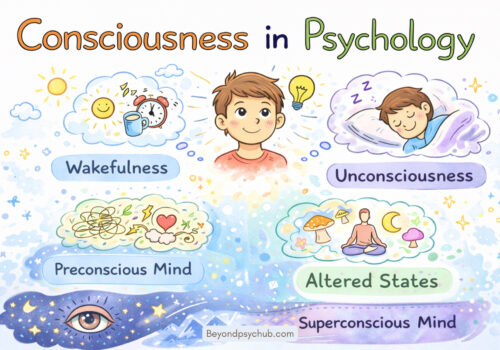
Psychologists often conceptualize consciousness as existing across multiple levels:
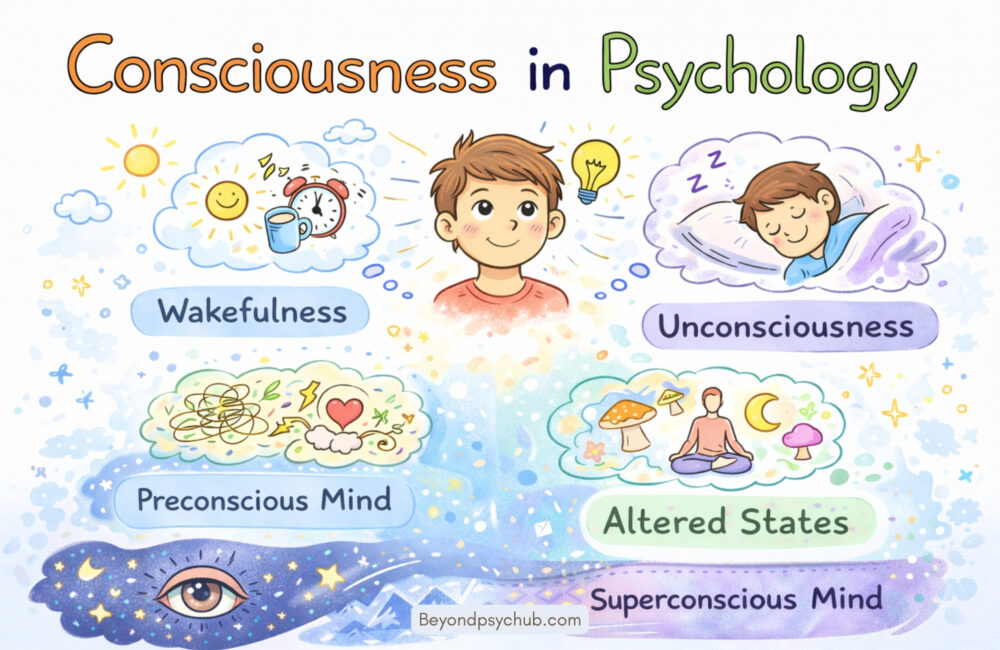
- Conscious Mind: The state of immediate awareness, including current thoughts, feelings, perceptions and environmental stimuli.
- Preconscious Mind: The realm where information is not currently in awareness but can readily be accessed when needed such as memories.
- Subconscious Mind: Mental processes operating below conscious awareness that influence habits, automatic responses, and emotional patterns.
- Unconscious Mind: A deeper, largely inaccessible reservoir of thoughts and feelings, fears, desires that are repressed or difficult to access but still significantly influence behavior and perception.
- Superconscious Mind: Described in certain psychological and spiritual theories, describe as heightened state of awareness such as enlightenment, creativity, or spiritual connection.
Different States of Consciousness
Consciousness is not static; shifts between various states depending on biological, psychological, and environmental conditions. Key states include:
- Waking consciousness: The state of being alert and engaged with the environment, characterized by logical thought, and focused attention.
- Sleep: Occurs primarily during REM (rapid eye movement) and non-REM stages, sleep is a vital state where consciousness is altered. Dreams occur during REM sleep, reflect subconscious processing.
- Dreaming: A state where subconscious thoughts surface, often abstract and symbolic.
- Hypnosis: An induced state of focused attention and heightened suggestibility, allowing individuals to access subconscious thoughts more easily.
- Meditative states: A practice of focused awareness, often used for relaxation, self-reflection, or mindful experiences.
- Altered states: Drug-induced or trauma-related shifts in perception that alter one’s awareness and connection with reality.
Difference Between the Unconscious and Subconscious Mind
The unconscious and subconscious mind though distinct, operate outside of direct awareness. The unconscious mind is often inaccessible, containing repressed memories, unresolved conflicts, and primal desires and drives. It impacts behavior through hidden motivations and unresolved emotional content. In comparison, the subconscious mind is more accessible containing information and patterns just below the level of awareness. The subconscious influences habits, beliefs, and automatic reactions. While the unconscious is often tied to psychoanalytic theories (like Freud’s), the subconscious is more commonly associated with automatic functions and habitual patterns.
How the Subconscious Influences Conscious Awareness
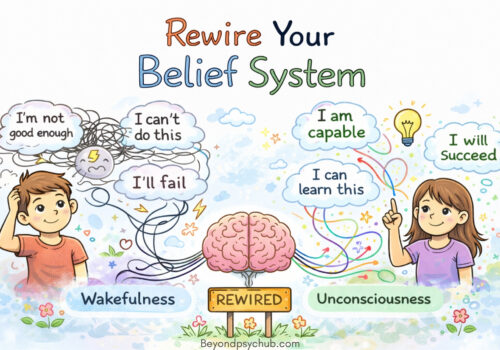
The subconscious mind plays a significant role in shaping conscious thought and behavior. Deeply ingrained beliefs and attitudes influence an individual’s perception of the world and their reaction to situations. Unresolved trauma and fears in the subconscious can surface in the conscious mind through stress, anxiety, or irrational behavior. Positive subconscious elements can manifest as self-confidence and resilience. By practicing self-affirmation techniques, and mindfulness, one can reprogram the subconscious to align with conscious goals.
Mental Disorders That Affect Consciousness
Several mental health disorders disrupt or distort normal consciousness, impacting both perception and self-awareness:
- Dissociative disorders: These include dissociative identity disorder (formerly multiple personality disorder) or a disconnection between consciousness and reality. Individuals may experience memory gaps, identity disturbances, or a feeling of detachment from reality.
- Schizophrenia: A serious mental disorder characterized by distorted thinking, hallucinations, and delusions altering an individual’s perception of reality.
- Trauma-related disorders: Post-traumatic stress disorder (PTSD) can alter consciousness, leading to flashbacks, hypervigilance, and dissociative episodes. The mind fragments reality to protect the individual from painful memories.
- Substance-induced disorders: Alcohol, drugs, and other substances can dramatically alter states of consciousness, either heightening perception (as with psychedelics) or dulling awareness (as with depressants).
Functions of Consciousness
Consciousness serves essential biological, cognitive, and social functions. It enables individuals to process information, make decisions, prioritize actions, and adapt to new environments or situations. Consciousness allows humans to evaluate their options, respond to stimuli and learn from experience. Consciousness is foundational for self-awareness, which is essential in many spiritual and religious contexts. Without consciousness or the ability to reflect on one’s existence and thoughts, self-awareness and spirituality would not be possible. This makes consciousness a bridge between mental processes and existential reflection.
Major Theories of Consciousness
Three prominent theories attempt to explain how consciousness emerges from brain processes:
- Global Workspace Theory: Proposes that consciousness is a product of widespread brain activity, allowing information from various regions to be broadcasted to other areas for processing.
- Integrated Information Theory (IIT): Suggests that consciousness is the result of the brain integrating information into a unified experience. The more integrated the information, the higher the level of consciousness.
- Higher-Order Theory: Suggests that consciousness arises from a system that can reflect on its own mental states. In this view, one becomes conscious when their brain creates a higher-order thought about a particular mental state.
Ways to Enhance and Regulate Consciousness
Research indicates that consciousness can be refined and improved through structured practices:
Mindfulness and Meditation.
Mindfulness and meditation practices improve attention, emotional regulation, present-moment awareness and cognitive focus, helping reduce stress and improve emotional regulation.
Sleep Optimization
Proper sleep hygiene enhances cognitive function, memory, and overall mental clarity. Sleep improves memory, regulates metabolism, and reduces mental fatigue. An adult needs a minimum of 7-8 hours of daily sleep for proper cognitive and behavioral function.
Neurofeedback
A technique that trains individuals to control brain waves activity by providing real time feedback through EEG sensors to improve cognitive and emotional functioning. It helps improve focus, relaxation, and emotional control, often used for conditions like ADHD, anxiety, and insomnia.
Cognitive-Behavioral Techniques
CBT helps rewire thought patterns through therapy can help align subconscious beliefs with conscious goals.
Psychedelic Substances
Controlled use of psychedelics in therapeutic settings has shown promise in expanding consciousness and providing insight into the subconscious.
The psychological study of consciousness provides a deeper understanding of how humans perceive reality, regulate emotions, and guide behavior. Understanding the levels, states, and theories of consciousness offers insight into how the mind works, thus helping create techniques to improve cognitive function and emotional well-being. These in turn increase self-awareness unlocks the full potential of the human mind.